Table of Contents
Thanks to the development of AI, machine translation tools can now produce translations that are far more natural and accurate than before. However, each tool has its own strengths, from document translation and content localization to business support. Below is a list of the TOP AI translation tools that are highly rated for accuracy based on user feedback.
TOP AI tools for highly accurate translation
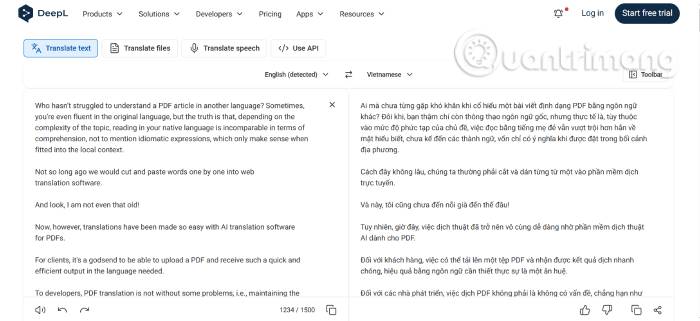
DeepL
DeepL is one of the world's most popular machine translation services, launched in 2017. Many consider it a premium alternative to Google Translate due to its superior ability to understand context and language nuances. DeepL is particularly highly regarded for translating European languages such as German, French, Spanish, Dutch, and Italian.
Advantage
- The translation is natural and smooth.
- High-quality translation of Word and PDF documents.
- Supports glossary of terms.
- Suitable for professional and business content.
Disadvantages
- Computer applications are sometimes unstable.
- The paid version has some limitations that leave professional users unsatisfied.
- Some users have reported that the service quality has slightly decreased compared to before.
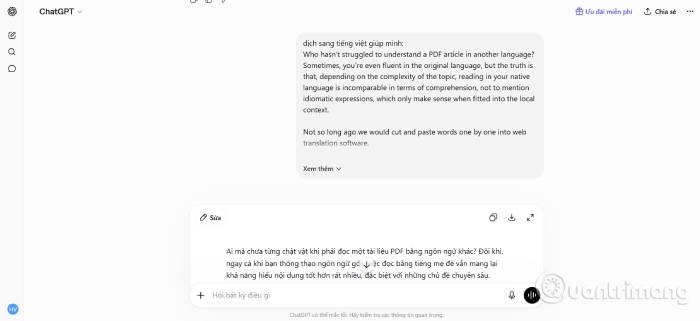
ChatGPT
OpenAI's ChatGPT is not just an AI chatbot, but also a very powerful translation tool thanks to its contextual understanding capabilities. Instead of translating individual sentences, ChatGPT can understand entire passages to produce more natural-sounding translations.
Advantage
- The writing style can be adjusted as needed.
- Translating long texts well.
- Support for localization and content rewriting.
- Understanding context is far better than many traditional translation tools.
Disadvantages
- Sometimes inaccurate information is produced.
- The original content may be misinterpreted.
- Not entirely consistent with technical terminology.
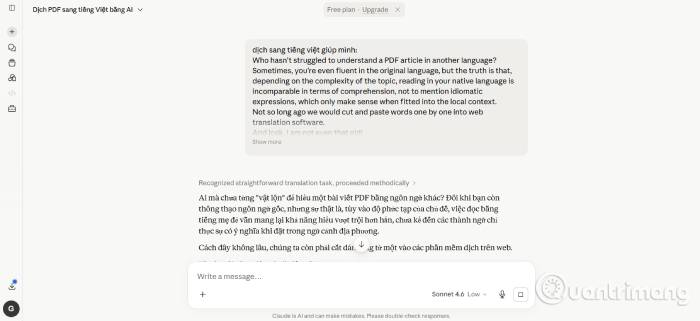
Claude
Claude is Anthropic's AI model, trained using Constitutional AI to generate safer and more reliable responses. In the field of translation, Claude often prioritizes notifying when encountering ambiguous content rather than making assumptions.
Advantage
- Excellent understanding of context.
- Supports multiple languages.
- Preserve the structure and meaning of the document.
- Suitable for content intended for customers or businesses.
Disadvantages
- Integrated ecosystems are limited.
- There are few specialized processes for translation and localization.
- We don't yet have as many business-specific tools as our competitors.
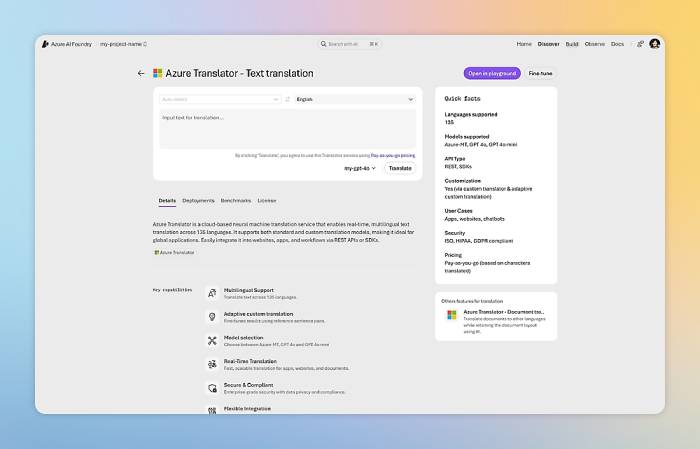
Azure AI Translator
Azure AI Translator is a translation service from Microsoft, developed from years of research in machine translation and now aimed at enterprise customers. This tool is particularly well-suited for integration into large applications or systems.
Advantage
- Easily integrates with the Microsoft ecosystem.
- Stable performance in a business environment.
- Suitable for translating software interfaces and large volumes of digital content.
Disadvantages
- Not really suitable for marketing purposes.
- The writing style is somewhat more literal than DeepL.
- Long translations sometimes sound unnatural.
Gemini
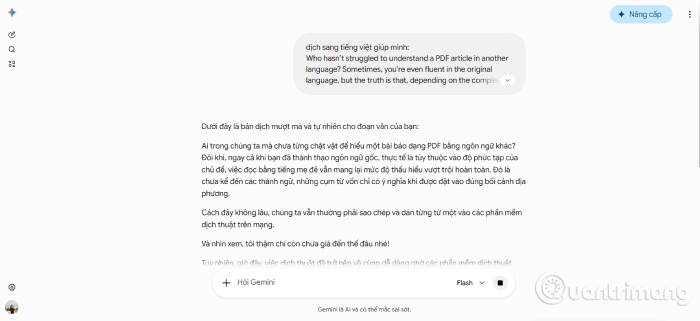
Gemini is Google's multimodal AI model, capable of translation among many other AI tasks. This tool is often used by businesses to localize marketing content, product messaging, and support multiple languages.
Advantage
- Good understanding of context.
- A natural writing style with content suitable for both general and business use.
- The writing style can be adjusted flexibly with guidance.
Disadvantages
- Idioms and cultural differences haven't been handled well.
- Accuracy is not yet truly stable in high-demand fields.
- Technical terminology may be inconsistent across lengthy documents.
Google Translate
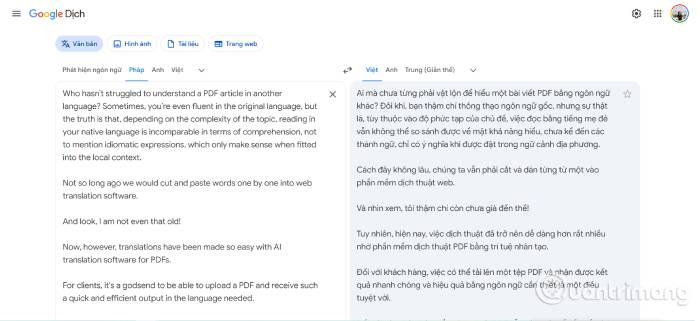
Google Translate has been around for over 20 years and now supports approximately 95% of the world's population. The service has been upgraded with the Gemini model and next-generation TPU hardware, serving over 1 billion users every month.
Advantage
- The translation was very fast.
- Supports a large number of languages.
- It has an offline translation mode.
- Machine translation technology is constantly improving.
Disadvantages
- Sometimes the context is misunderstood.
- Not suitable for professional documentation.
- The writing style is less natural than DeepL or ChatGPT.
Related Articles
 DeepL - an Advanced AI-based Online Translation Tool7 minutes read
 Facebook Published 9 Times More Accurate Language Translation Tool Research Results6 minutes read
 Google Translation: People Translate Tools Automatically3 minutes read
 Top Best Browser Tools to Translate Websites: What You Need to Know7 minutes read
 Translate English on the Phone with Quality Translation Apps8 minutes read
 Online Translation Software: Quality Should Be Paid Attention To9 minutes read
Reader Comments 0
Sign in with email or Google to join the discussion.