Table of Contents
This article provides a clear overview of This Is the Simplest and Most Economical Way to Increase AMD, with the main facts, useful context, and practical details organized for easy reading.

In recent years, AMD's Crossfire solution has been replaced by XDMA, a protocol that helps to combine the power of graphics cards in a system on PCIe. Meanwhile, Crossfire's counterweight is NVIDIA SLI has been replaced with NVLINK and only available on high-end graphics cards (RTX 2070 and above). In theory, AMD's XDMA does not support two different graphics cards, but through the DirectX 12 and API graphics APIs (the two most popular APIs by game developers today), this has been realized. chemistry.
One problem to note is that due to not being really optimized, we will only get the parameters of Rise of The Tomb Raider and Strange Brigade, 2 games that run well without crashing.
Configuration used for testing:
- CPU: AMD Ryzen 7 3700X - Mainboard: ASRock X570 Taichi - RAM: 16GB 3200MHz - SSD: 512GB - GPU: ASUS Radeon RX 5700 Dual EVO (8GB) in combination with ASUS Radeon RX 5600 XT TUF3 EVO Gaming (6GB). Both run on AMD Adrenaline Radeon Software driver 20.2.1.
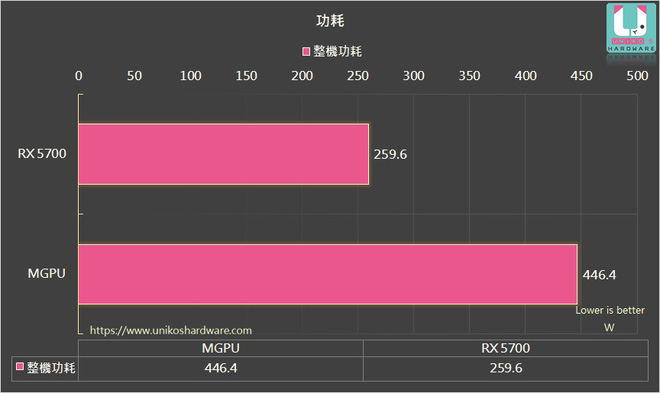
In terms of power consumption, the tested graphics card combo has an increase of 70% compared to an RX 5700 alone.

In terms of 3Dmark Time Spy, RX 5700 and RX 5600XT combos achieved 14,156 graphics points and 13,1342 points overall. That's 72% higher than a single-run RX 5700.

Regarding the game, when playing Strange Brigade at Ultra setting (DX12), this combo averages 228.8 FPS and a low 1% rate to 151.2 FPS. Meanwhile, an RX 5700 can only reach 138.6 FPS and 98 FPS respectively. Thus the difference in performance is about 65%.

Similar to the Rise of The Tomb Raider, the figures are 191.3 FPS and 111.5 FPS when combined and 116.9 FPS and 87.4 FPS respectively when running RX 5700 separately. The figure is 71.6%. It turns out, with the power consumption increasing by about 70%, the investment also increasing by about 70%, we achieve the performance corresponding to that number.
Of course, it's undeniable that even without official support from AMD as well as game developers, these are very promising numbers. Hopefully multi-graphics cards will return to the trend, especially for gamers who do not need comprehensive upgrades every 1-2 years.
FAQ
What is the main focus of This Is the Simplest and Most Economical Way to Increase AMD?
The article explains the most important facts, context, and practical details related to This Is the Simplest and Most Economical Way to Increase AMD.
Who may find this information useful?
It is useful for readers who want a clear overview, practical context, and a better understanding of the subject.
What should readers verify before taking action?
Check current product versions, official requirements, regional availability, and any details that may have changed since the original publication.
Related Articles
 Radeon VII Vs RTX 2080: Which GPU Should You Buy in the 700 USD Segment?14 minutes read
 AMD Radeon RX 6600 XT: as Strong as NVIDIA GTX 1080 Ti5 minutes read
 AMD Radeon: Complete Guide9 minutes read
 Amd Released Two New Generation GPU Models, Radeon Pro W5500 and3 minutes read
 What Is AMD Radeon Installation?11 minutes read
 AMD Radeon 800M iGPU with 16 RDNA 3.5 Cores Scores More Than 36004 minutes read
Reader Comments 0
Sign in with email or Google to join the discussion.