Table of Contents
This is an archived guide for TFT Set 15, K.O. Coliseum—not the current live-set meta. Set 15 launched with patch 15.1 in July 2025 and has since rotated out. Use this guide for historical reference, a Set 15 revival if Riot brings one back, or to understand the composition shown in the screenshots.
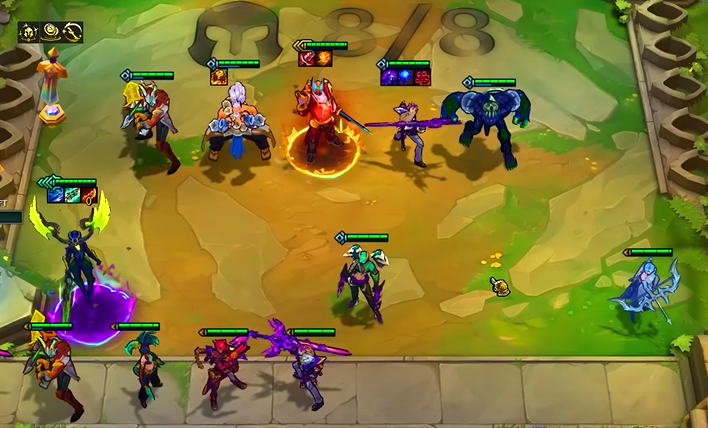
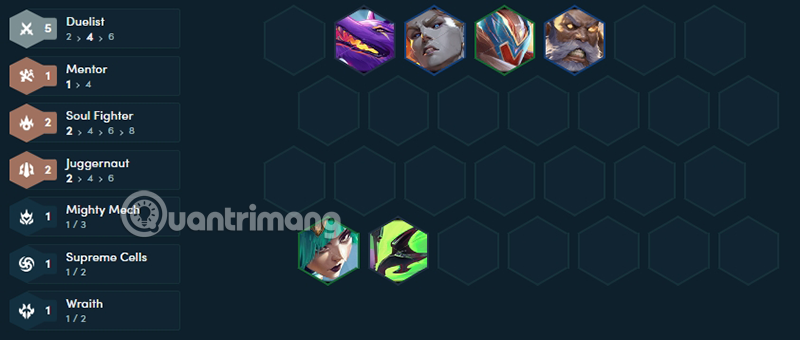
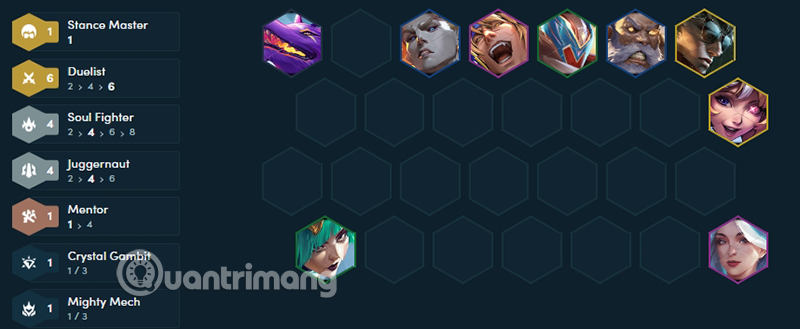
Duelist was a vertical attack-speed trait. Its units gained more attack speed as they attacked, rewarding long fights and a stable front line. The standard six-unit core was Kayle, Gangplank, Kai’Sa, Viego, Udyr, and Ashe; Lee Sin could adopt Duelist Stance as a flexible five-cost option.
Duelist trait breakpoints
| Duelists | Set 15 effect | Practical meaning |
|---|---|---|
| 2 | 4% attack speed per attack | A small splash for an early board or a secondary carry |
| 4 | 7% attack speed per attack | A useful mid-game breakpoint without forcing every Duelist |
| 6 | 10% attack speed per attack and 12% durability | The full vertical payoff and the usual late-game target |
The attack-speed bonus stacked up to 12 times. That made survivability important: a carry that died or was crowd-controlled early could not build stacks. Exact values were subject to patch changes, so consult the relevant archived Riot TFT patch notes when recreating a board from a specific tournament or patch.
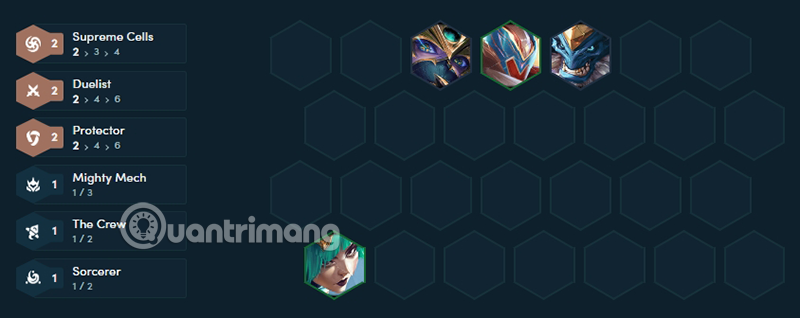
Set 15 Duelist roster
| Champion | Cost | Other traits | Typical job |
|---|---|---|---|
| Kayle | 1 | Wraith | Early ranged damage and trait access |
| Gangplank | 2 | Mighty Mech | Early melee damage and item holder |
| Kai’Sa | 2 | Supreme Cells | Early-to-mid ranged carry or reroll option |
| Viego | 3 | Soul Fighter | Melee damage and mid-game stabilization |
| Udyr | 3 | Mentor, Juggernaut | Durable frontliner or melee carry |
| Ashe | 4 | Crystal Gambit | Primary back-line carry in the vertical line |
| Lee Sin | 5 | Stance Master | Late-game flex unit when Duelist Stance is selected |
Lee Sin was not automatically a Duelist in every game. His Stance Master mechanic let the player choose Duelist, Executioner, or Juggernaut Stance, each with a corresponding ability. Riot’s K.O. Coliseum overview documents the Set 15 roster and this choice.
Item priorities
Ashe
- Kraken’s Fury: paired naturally with a carry that attacks repeatedly and was specifically supported by later Set 15 balance changes.
- Last Whisper: supplied armor reduction when the lobby contained armored front lines.
- Infinity Edge or Giant Slayer: chose burst consistency or anti-high-health damage according to the lobby.
Guinsoo’s Rageblade was playable, but Duelist already supplied stacking attack speed. A damage item could be more valuable when the trait and Power Up covered speed. Kai’Sa was the cleanest early holder for Ashe’s physical carry components.
Udyr and Viego
- Bloodthirster for healing and a low-health shield.
- Sterak’s Gage for durability on a melee holder.
- Titan’s Resolve or Hand of Justice for mixed offense and sustain.
A tank-oriented Udyr could instead use items such as Spirit Visage and Gargoyle Stoneplate. Avoid splitting three mediocre defensive items across several frontliners when one upgraded Udyr must buy time for Ashe to stack.
Lee Sin
Lee Sin generally accepted leftover melee carry or tank items. His chosen stance and the rest of the board mattered more than forcing a fixed three-item recipe.
Standard six-Duelist leveling line
Stage 2: play the strongest available board
- Open with two Duelists when the units are upgraded; do not field weak one-star pieces only for the trait.
- Kayle, Gangplank, and Kai’Sa can hold components while a Protector, Bastion, Heavyweight, or Juggernaut supplies a real front line.
- Build a useful item early if it preserves health. Waiting for a perfect Ashe set can cost too much Tactician health.
Stage 3: stabilize at four Duelists
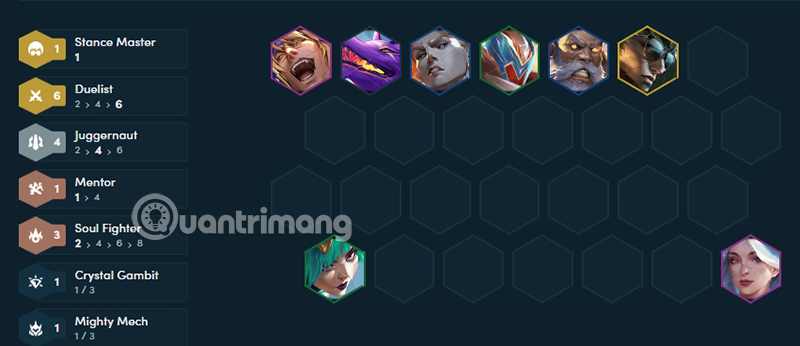
- Add Viego and Udyr as they appear, but keep strong upgraded support units until each replacement improves the board.
- Four Duelists plus two durable or utility units was often stronger than six Duelists with multiple one-star frontliners.
- Choose one economy plan. A two-cost reroll line for Kai’Sa and Gangplank rolled mainly at level 6; a three-cost Viego or Udyr line rolled at level 7. The Ashe line usually preserved gold and leveled.
Stage 4 and later: find Ashe and complete the core
- Reach level 8 with enough gold to find Ashe and upgrade the three-cost front line.
- Field Kayle, Gangplank, Kai’Sa, Viego, Udyr, and Ashe for six Duelists, then use remaining slots for frontline, crowd control, or a valuable secondary trait.
- Replace the weakest trait unit only when Lee Sin selects Duelist Stance and the board keeps the desired breakpoint.
- Do not roll for Kai’Sa as a late-game four-cost; she was a two-cost unit and should already be upgraded or used as an item holder.
Positioning and decision checks
- Protect Ashe: place her away from the enemy’s fastest access route, then move her after scouting hooks, divers, and area damage.
- Give melee carries a target: position Viego or Gangplank so they do not walk across the board before attacking.
- Do not clump blindly: spread against large area-of-effect abilities, but keep enough coverage to stop back-line access.
- Watch the lobby: contested Ashe or Udyr copies reduce upgrade odds; pivot to the reroll line only when the shop and items support it.
- Treat items as patch-dependent: Power Ups and balance changes altered optimal builds during K.O. Coliseum.
Because Set 15 is no longer live, this composition should not be presented as a current ladder recommendation. For broader context on the genre, see TipsMake’s overview of mobile auto battlers including TFT. A later-set example is the archived TFT Set 16 Targon team guide; its units and traits are not interchangeable with this board.
Related Articles
 KaiSa TFT Season 11: Item Builds, How to Build, and Team Composition Guides4 minutes read
 How to Play the High-Tech Team Composition in TFT Season 149 minutes read
 Teamfight Tactics Season 11 Destiny Lineup: Gameplay and Item Build7 minutes read
 How to Play the Taurus Team Composition in TFT Season 149 minutes read
 How to Build the DTCL Secret Team DTCL Season 38 minutes read
 Teamfight Tactics Gang Composition, TFT Gang Gameplay Guide Season 149 minutes read
Reader Comments 0
Sign in with email or Google to join the discussion.