Table of Contents
MiMo Code is an open-source, terminal-based coding agent from Xiaomi's MiMo team. It can inspect and edit files, run shell commands, work with Git, call MCP tools, and retain project information across sessions. Its distinguishing feature is a reviewable persistent-memory system rather than reliance on a single model context window.
MiMo Code began as a fork of OpenCode and is published under the MIT license, with additional use restrictions and separate terms for Xiaomi-hosted services. The project is developing quickly, so check the current release notes instead of installing the original 0.1.0 build.
What MiMo Code does
- Runs as a terminal user interface on Windows, macOS, and Linux.
- Reads and edits a repository, executes commands, and manages Git.
- Supports Xiaomi models as well as other model providers and OpenAI-compatible APIs.
- Offers Build, Plan, and Compose-style workflows with subagent support.
- Stores project memory, checkpoints, notes, and task progress outside the immediate chat context.
- Supports plugins, language-server features, MCP integrations, and custom commands inherited from its OpenCode foundation.
Persistent memory: the main idea
Long coding sessions eventually exceed a model's active context. Compaction can preserve a summary, but it may omit a design decision, an unresolved failure, or a repository convention. MiMo Code addresses this with files that can be searched, inspected, and edited:
| Memory layer | Purpose |
|---|---|
MEMORY.md | Project background, durable rules, architecture decisions, and repeatedly verified facts |
checkpoint.md | A structured snapshot of the current session maintained by a checkpoint-writer agent |
notes.md | Temporary working notes |
tasks/<id>/progress.md | Progress and state for an individual task |
The SQLite FTS5 index helps retrieve the relevant records, while the Markdown files let a developer correct stale or inaccurate memory. That reviewability matters: a persistent mistake can otherwise influence many later sessions.
Dream and Distill
MiMo Code's Dream process reviews older sessions and memory, then merges duplicates, checks paths, removes outdated material, and compresses the result. Distill looks for repeated work patterns and can turn them into reusable skills, commands, agents, or operating procedures.
Current releases can change whether these maintenance jobs run automatically; in version 0.1.10, automatic Dream and Distill were disabled by default. Check the installed version's configuration before assuming either process is active.
Build, Plan, and Compose workflows
- Build: the default development mode with tools that can modify files and run commands.
- Plan: a read-only mode for exploring code and designing an implementation before edits.
- Compose: an orchestration workflow for specification-driven work and reusable skills. Some newer model setups instead recommend the Build agent with a Compose skill.
Start an unfamiliar or sensitive repository in Plan mode. Move to Build only after reviewing the intended files, tests, and commands. Compose can be useful for a long task, but more autonomy also makes permission boundaries and checkpoints more important.
Installation and first launch
The official project offers platform installers and an npm package. If Node.js and npm are already installed, the cross-platform command is:
npm install -g @mimo-ai/cli
mimo
The first launch presents model-access choices. Depending on the current release, these may include Xiaomi's platform, another provider through OAuth or API key, importing supported configuration, or a custom OpenAI-compatible endpoint.
The original limited free MiMo-V2.5 channel ended in July 2026. Do not install MiMo Code on the assumption that continued model use is free; review the provider's current pricing, quota, and data terms.
Xiaomi's performance claims
Xiaomi reported that MiMo Code with MiMo-V2.5-Pro scored higher than Claude Code with Claude Sonnet 4.6 on three coding-agent benchmarks:
| Benchmark | MiMo Code + MiMo-V2.5-Pro | Claude Code + Sonnet 4.6 |
|---|---|---|
| SWE-bench Verified | 82% | 79% |
| SWE-bench Pro | 62% | 55% |
| Terminal-Bench 2 | 73% | 69% |
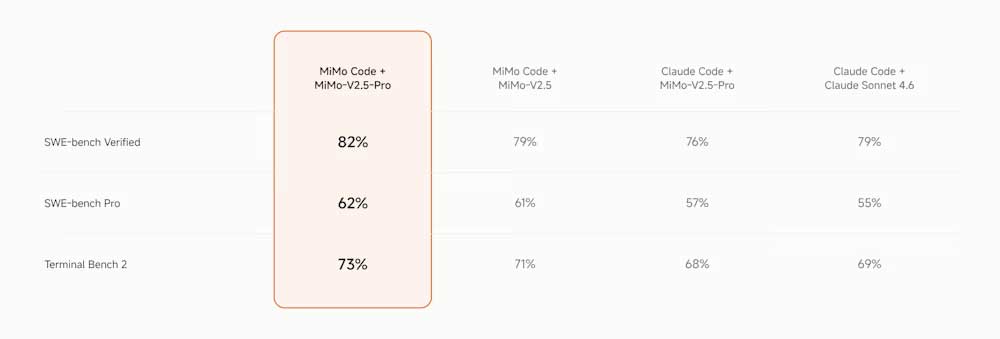
These are developer-published results, not a guarantee that MiMo Code will outperform another agent on a specific repository. The systems may use different prompts, scaffolding, permissions, tools, retry policies, and model versions. Reproduce a representative task on your own codebase before selecting a tool for a team.
Xiaomi also reported an internal double-blind evaluation covering 576 developers, 474 private repositories, and 1,213 judged A/B pairs. The company said win rates were close for tasks below 200 steps and favored MiMo Code above that threshold. The repositories and full independent replication data are not public, so treat the result as evidence supporting Xiaomi's design claim rather than a neutral comparison.
MiMo Code vs Claude Code
| Area | MiMo Code | Claude Code |
|---|---|---|
| Source availability | Open-source agent framework derived from OpenCode | Proprietary product |
| Model choice | Supports multiple providers, including Xiaomi and custom endpoints | Designed around Anthropic models, with supported integrations |
| Persistent project memory | Explicit Markdown layers plus search index and maintenance workflows | Project instructions and product-specific context features |
| Terminal actions | File edits, commands, Git, tools, and subagents | File edits, commands, Git, tools, and subagents |
| Best evaluation method | Run the same repository task with the same acceptance tests, permissions, and human review | |
The choice is not only about benchmark percentage. Consider supported models, code-governance requirements, latency, cost, editor workflow, team controls, and how easily you can audit an agent's changes and memory.
Security and privacy checklist
- Commit or stash work before allowing an agent to edit the repository.
- Review the proposed plan and every diff; run tests independently.
- Keep secrets out of prompts, logs, memory files, and version control.
- Confirm which provider receives code and prompts. Open-source client code does not mean hosted inference is local or private.
- Use the least-permissive mode that can complete the task.
- Do not use
--dangerously-skip-permissionsfor ordinary development. - Do not enable automatic approval for destructive commands on a shared or important machine.
- Review
MEMORY.mdand checkpoints for inaccurate or confidential information before committing or sharing the project. - Run untrusted repositories and experimental autonomous workflows in an isolated environment.
Who should try MiMo Code?
MiMo Code is worth testing if you want an auditable cross-session memory system, a provider-neutral terminal agent, or an open framework that can be extended. It is less compelling if your team needs a mature managed product, stable enterprise controls, or a benchmark result that has been independently reproduced.
Evaluate it with one bounded task: define the acceptance tests, record time and model cost, inspect the memory it creates, and compare the final diff with your current coding assistant. That provides more useful evidence than a vendor leaderboard alone.
Related Articles
 Tips for Using Claude AI to Program Effectively for Beginners8 minutes read
 OpenCode Vs Claude Code: Which AI Programming Tool Should You Choose in 20268 minutes read
 How to Work More Effectively With Claude Code12 minutes read
 What Are Plugins in Claude Code?7 minutes read
 Why Do Developers Always Choose Claude Over Other AIs?11 minutes read
 Claude by Anthropic: Explained5 minutes read
Reader Comments 0
Sign in with email or Google to join the discussion.