Table of Contents
ChatGPT is often more useful for brainstorming when it asks you questions before proposing solutions. This slows down premature answers, exposes assumptions, and gives the model enough context to suggest ideas that are different from what you already tried.
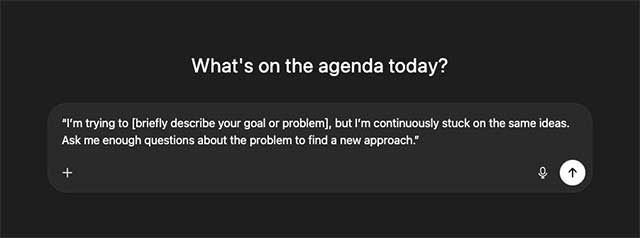
Start with the problem and the desired outcome
Describe the decision or obstacle in plain language. Include the audience, constraints, and what a good result would change. A useful starting prompt is:
I'm trying to [goal], but I keep returning to the same ideas.
Before suggesting solutions, ask me one question at a time to uncover:
- assumptions I may be making,
- constraints that are real versus assumed,
- what I have already tried,
- evidence that would change the decision.
After enough context, summarize the problem and propose three distinct approaches.
“One question at a time” makes it easier to answer carefully. If you prefer speed, ask for a short batch of five questions instead.
Tell ChatGPT what you have already tried
List previous approaches and their results. Distinguish evidence from interpretation:
- Evidence: what users did, what a test measured, or what happened.
- Interpretation: why you think it happened.
- Constraint: budget, time, policy, technology, or risk that limits the solution.
This prevents the conversation from repeating obvious advice and gives ChatGPT material to challenge.
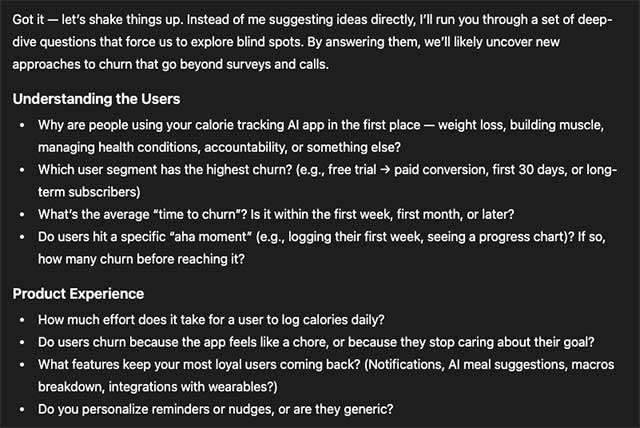
Use different lenses deliberately
If the questions stay too close to your original framing, ask ChatGPT to inspect the problem from several angles:
Examine this problem through five lenses:
1. the user's underlying job,
2. incentives and friction,
3. an opposing viewpoint,
4. a low-cost reversible experiment,
5. what would make the problem disappear rather than improve.
Ask what information is missing before giving ideas.
For a product-retention problem, this might separate acquisition mismatch, weak onboarding, delayed value, pricing friction, and users who completed their goal. Those causes require different interventions.
Ask for competing explanations
ChatGPT can sound confident even when the evidence is incomplete. Use it to generate hypotheses, not to declare the cause:
Give me three plausible explanations for this result.
For each one, state:
- supporting evidence,
- evidence against it,
- the cheapest test that could distinguish it from the others.
Do not assume the most familiar explanation is correct.
This turns brainstorming into a testable process rather than a list of attractive ideas.
Move from ideas to small experiments
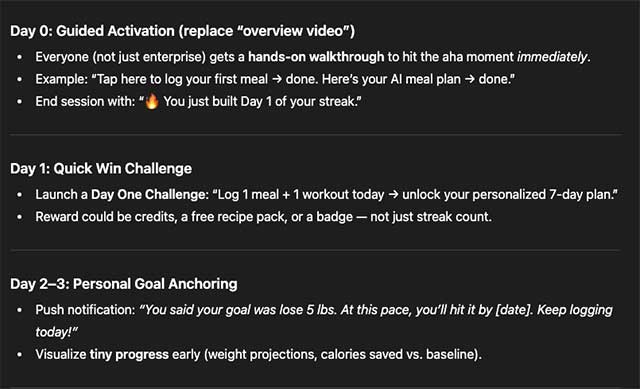
After exploring the problem, ask ChatGPT to convert promising ideas into reversible tests. A useful output includes the hypothesis, target group, change, success measure, guardrail, duration, and decision rule. Remove invented figures and provide the real baseline where numbers matter.
Check the final synthesis
Before acting, ask ChatGPT to separate what came from you, what it inferred, and what still needs verification. Review factual claims and current information independently. For high-stakes medical, legal, financial, employment, or security decisions, use qualified professional guidance and authoritative sources.
A reusable reflection prompt
Summarize our discussion in four parts:
1. confirmed facts,
2. assumptions,
3. unresolved questions,
4. next experiments ranked by learning value and effort.

Point out where my answers contradict each other.
Do not invent evidence, user feedback, or metrics.
OpenAI's official prompting guide recommends stating the goal, useful context, desired output, and important boundaries, then refining the result through follow-up messages. The same structure makes question-led brainstorming more focused.
Related Articles
 Task Ideas to Optimize ChatGPT-5: Complete Guide24 minutes read
 Does ChatGPT Really Make Us 'Lazier' and 'Less Intelligent'?6 minutes read
 This Prompt ChatGPT Will Expose the Weaknesses in Any Idea!8 minutes read
 How to use ChatGPT to unlock your hidden potential4 minutes read
 How to Personalize ChatGPT 5 for a More ChatGPT 4-Like Experience8 minutes read
 How to Use ChatGPT Voice Mode to Take Notes: Step-by-Step Guide8 minutes read
Reader Comments 0
Sign in with email or Google to join the discussion.