Table of Contents
This updated guide explores Google synthid detector identifies ai-generated content with practical details, clear explanations, and useful takeaways. During the Google I/O 2025 developer conference, Google announced major updates to its SynthID tool - an AI-powered image watermarking solution. Notably, a feature called SynthID Detector helps quickly and efficiently identify AI content created with Google's AI tools.
Advances in generative AI are helping people create content in entirely new ways—from text to high-quality audio, images, and video. As these capabilities grow and become more widespread, the issues of authenticity, context, and verification become more pressing.
SynthID Detector can detect AI-generated content across multiple modalities, and highlight pieces of content that are likely to be watermarked with SynthID. Google introduced this AI watermarking tool in 2023 and later updated it to support AI-generated text and video. This watermarking technique was added to Magic Editor in Google Photos earlier this year.
SynthID has been used to watermark over 10 billion pieces of content; it supports Gemini, Imagen, Lyria, and Veo models. Google claims that SynthID can preserve content quality and 'acts as a robust watermark that remains detectable even when the content is shared or undergoes multiple transformations.' The watermark remains detectable after edits such as adding filters, changing color, and brightness.
Using SynthID Detector, users can upload content types such as images, music, videos, or text generated by Google's AI engine. The portal will scan for watermarks and display results, highlighting affected sections. For audio content, the tool will point out specific segments containing the SynthID watermark.
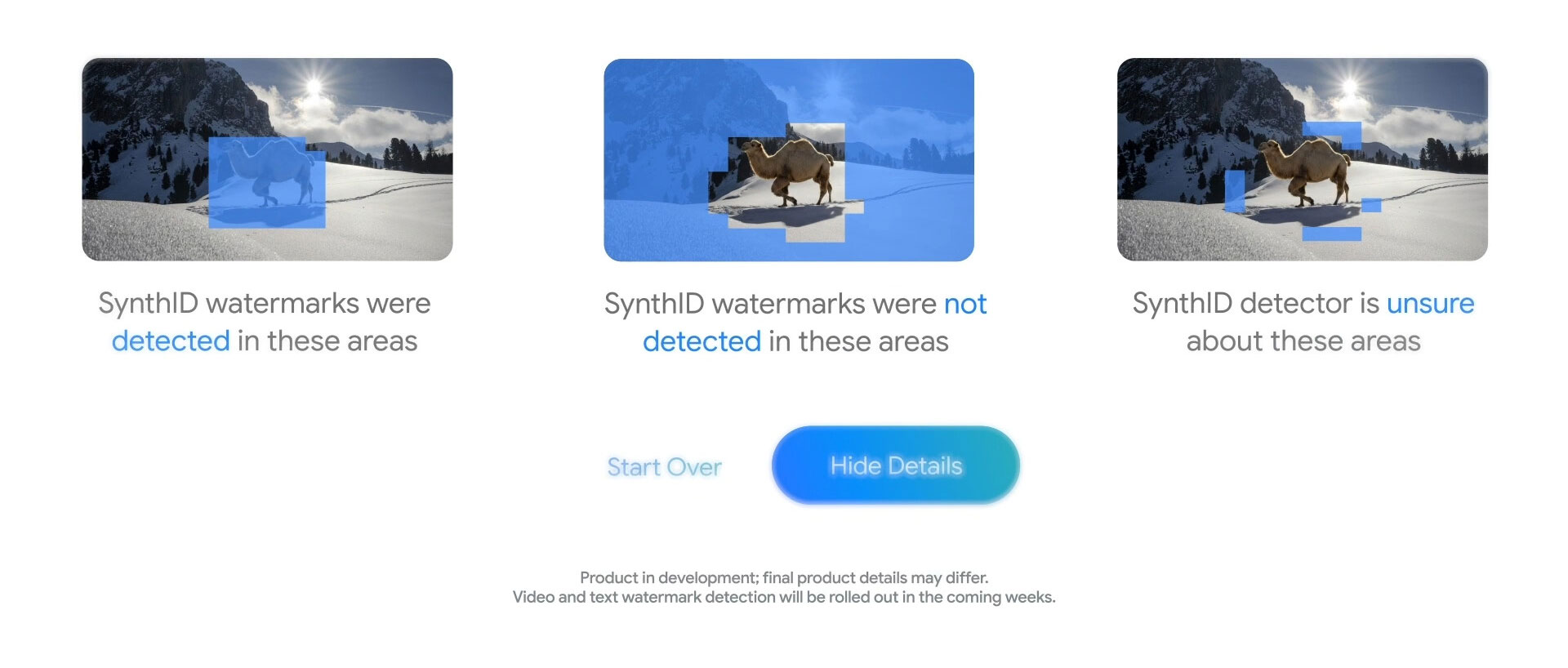
SynthID Detector is still in development and rolling out to early beta users. Google says the tool will be available to more users in the future, and encourages interested researchers and media professionals to sign up for the waitlist.
Google's product debuts nearly a month after Adobe released its AI content watermarking tool Content Authenticity in public beta. The search giant is working to build an ecosystem around SynthID, including open-sourcing the code and partnering with NVIDIA to watermark videos created by the company's AI models.
FAQ
What is the main takeaway about Google SynthID Detector Identifies AI-Generated Content?
The key is to understand the core idea, compare the available options, and apply the practical guidance that matches your situation.
What should beginners know about Google SynthID Detector Identifies AI-Generated Content?
Start with the essential steps and terminology. Avoid changing advanced settings until you understand how they affect performance, privacy, cost, or compatibility.
How can I use this information in practice?
Follow the relevant section in order, test one change at a time, and confirm the result before moving to the next step or recommendation.
Related Articles
 How to AI Text Detection Using Canva's AI Detector3 minutes read
 TOP Most Accurate AI Content Detection Tools11 minutes read
 Google Is Developing an AI Tool That Specializes in Newspaper Writing3 minutes read
 New Algorithms to Increase the Accuracy of Captcha4 minutes read
 Xiaomi Launched a Hidden Camera Detector, Priced at Vnd 330,0003 minutes read
 Google Launched a New 'Take Down' Network Tool3 minutes read
Reader Comments 0
Sign in with email or Google to join the discussion.