Table of Contents
This guide provides a practical overview of Good Tip for the Magic Keyboard of iPad Pro, including its main features, benefits, limitations, and important considerations.
1. Use the USB-C port on the keyboard
Apple made the wise decision to give the Magic Keyboard a USB-C port. You can charge your iPad via this port, and the other port on the device will be used to connect more accessories, such as SD card readers or camera devices. This USB-C port also lets you charge an Apple Watch or connect iPad Pro to external monitors.
2. Create the Esc key
The Magic Keyboard for iPad Pro is not equipped with the Esc key, but there are a few ways to help you create that useful key. Replace Esc by pressing Command + Period . If it does not exit the program as the Esc key function, you can change some keyboard settings from the device.
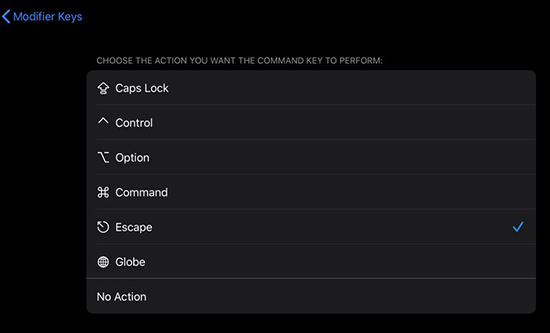 Customize the Esc key
First, connect the Magic Keyboard to iPad Pro, then turn on Settings , select General> Keyboard> Hardware Keyboard . Next, select Modifier Keys , then select any key you want to use as the Esc key. Select Escape in the next step and you can use the selected key.
3. Quick connection to the virtual keyboard
If you need to use the on-screen virtual keyboard to work simultaneously, press the lower arrow key on the Magic Keyboard and then hold down the conical icon on the right corner of the iPad screen. To hide the keyboard, press the icon again.
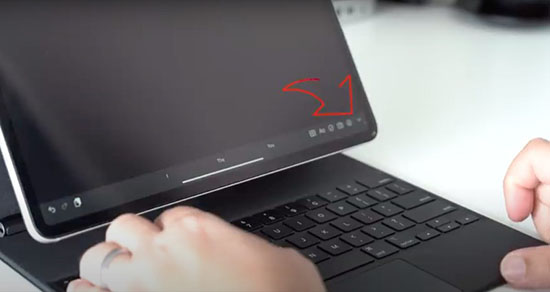 Reverse cones icon to open the virtual keyboard
4. Manage touch operations
If you have difficulty with touch screen on iPad Pro, you can change many functions and manipulations by using hard keys on Magic Keyboard. Once the keyboard is connected, turn on Settings , select Accessibility> Keyboards> Full Keyboard Access .
You can customize a lot of operations or functions for use on the Magic Keyboard's hard keyboard.
5. Customize keyboard brightness
Perhaps the only weakness of the Magic Keyboard is the lack of a row of function keys above. This makes it impossible for users to quickly adjust some simple system functions, such as keyboard brightness.
Magic Keyboard uses the iPad Pro's sensor to recognize ambient light and adjust the keyboard brightness accordingly. But the ability to self-adjust is still not appropriate, you can adjust it as you like. However, it is not as simple as pressing a key like on a regular keyboard.
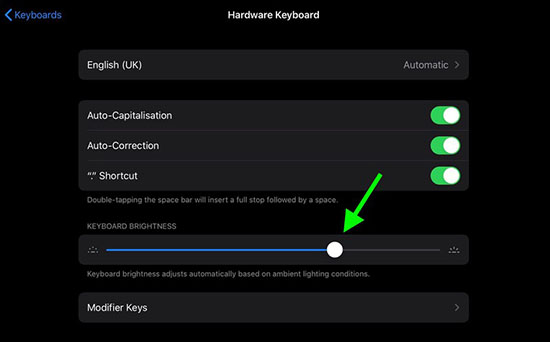 Adjust or decrease the keyboard brightness
In Settings choose General> Keyboard> Keyboard Hardware , and then drag the bar to increase or decrease the brightness and how familiar the screen brightness.
6. Customize cursor behavior
iPadOS lets you customize the behavior and appearance of the trackpad cursor on the iPad screen. These include pointer contrast, color change, size, surfing speed and the ability to hide when inactive. You can set it in Settings> Accessibility> Pointer Control .
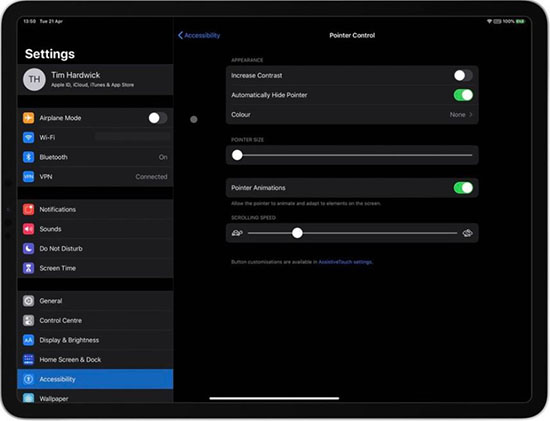 Adjust pointer behavior
7. Click one touch and two fingers instead of right mouse
If you're using a Mac, you're probably familiar with one-touch clicks. You can tap once to open the application without applying force to the trackpad.
Apple also has that feature on the iPad Pro's Magic Keyboard. In Settings , choose General> Trackpad , then pushed the button Tap to Click . Now you can use the trackpad exactly as you do on a Mac.
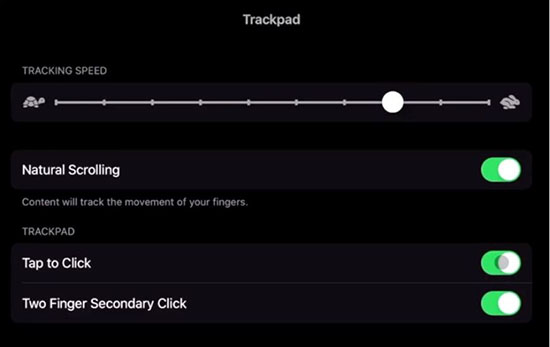 Touch operation on the trackpad
Similarly, two fingers instead of right mouse can be installed by pressing the button next to the Two Finger Secondary Click option in the same Trackpad menu as above.
8. Manipulating Trackpad
As expected, the Magic Keyboard supports new trackpad operations. For example, you can get into Slide Over multitasking by moving the cursor to the right of the screen or removing an app from the Dock.
Two- and three-finger gestures can also be used on Magic Keyboard. For example, on the home screen, swipe down from two fingers to open Spotlight search. If you're using Photos, you can zoom in or out of the image using two fingers on the trackpad. Scrolling up and down on the web is no different than traditional Mac trackpads.
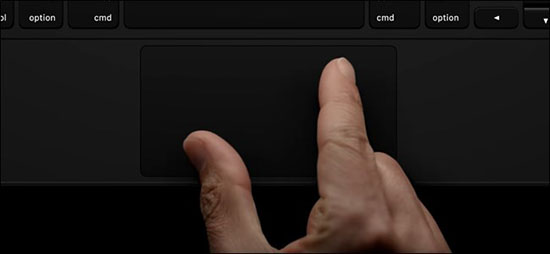 Familiar image zoom operations can also be used on the keyboard trackpad
Swiping down with three fingers will help you return to the home screen immediately. And vice versa, swipe up using three fingers, iPad Pro will appear. Swiping left or right (also with three fingers) will be how you switch between running apps.
9. Emoji Keyboard
How to switch to emoji keyboard on Magic Keyboard is also very easy. Whenever you are typing, press the globe key (the key with the globe icon as on the virtual keyboard) in the lower left corner.
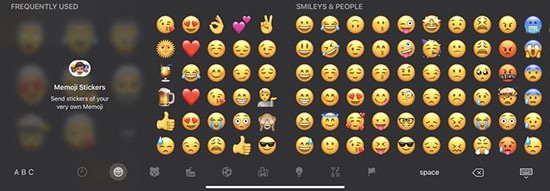 Emoji keyboard
The emoji keyboard will appear or you will have to switch to many other language keyboards before you can get to the emoji (similar to the virtual keyboard on the screen).
10. 'easel' mode
To hold the iPad Pro horizontally, turn it horizontally and place it on the case of the Magic Keyboard. Now you have the perfect easel for your iPad.
The construction of this device can be used for drawing, making Facetime calls or watching movies. It is not very sure, but at least it can help you in some cases too tired.
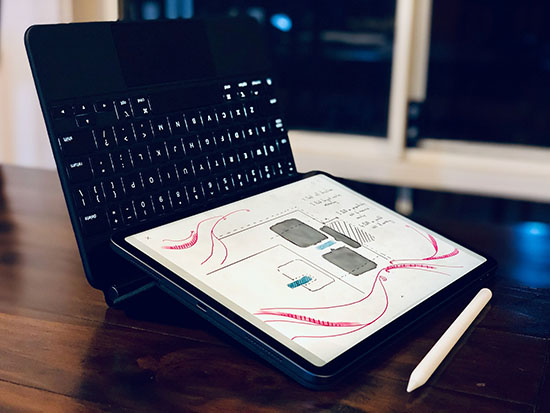 Magic Keyboard can turn into a holder for iPad Pro
FAQ
What should I know about Good Tip for the Magic Keyboard of iPad Pro?
Focus on the key features, requirements, limitations, and practical use cases explained in this guide.
How do I get the best results with Good Tip for the Magic Keyboard of iPad Pro?
Follow the recommended steps, use current software or information, confirm compatibility, and review settings before major changes.
Are there any risks or limitations?
Potential limitations depend on compatibility, data quality, cost, privacy, support, and how the product or method is used.
Related Articles
 Experience the Fast Magic Keyboard of iPad ProMacBook4 minutes read
 Does the New Magic Keyboard with Apple's Trackpad Support2 minutes read
 Meet the Flip Folio: Apple's iPad Keyboard Alternative9 minutes read
 iPad Pro 2020: So Powerful It Could Be Your Next Computer4 minutes read
 The Keyboard for the iPad Pro 2020 Is Just as Expensive as a4 minutes read
 Should I Use Cheaper Magic Keyboard Alternatives?6 minutes read
Reader Comments 0
Sign in with email or Google to join the discussion.