Table of Contents
Chinese chess, or Xiangqi, is played by two people with 16 pieces each. Red normally moves first, then the players alternate one move at a time. The aim is to leave the opposing general with no legal escape from check; a player who has no legal move also loses, even when the general is not in check.
The board and starting position
The board has nine vertical files and ten horizontal ranks, creating 90 intersections. Place pieces on the intersections, not inside the squares. The river separates the two halves. Each side's palace covers the central three files and the nearest three ranks, giving nine points marked by diagonal lines.
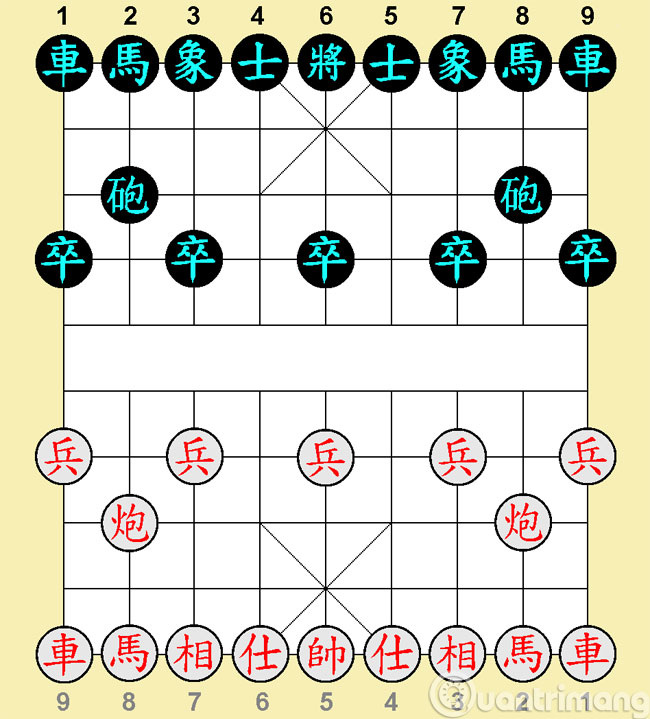
Each side starts with one general, two advisors, two elephants, two horses, two chariots, two cannons and five soldiers. From left to right, the back rank is:
Chariot – horse – elephant – advisor – general – advisor – elephant – horse – chariot.
Counting your back rank as rank one, place the cannons on rank three, one file in from each edge. Place the five soldiers on rank four, on alternating files: first, third, fifth, seventh and ninth. Set up the other side as a mirror image.
Recognize the seven pieces
Red and black pieces may use different Chinese characters for the same role. Character styles also vary between sets. Learn the role and starting position together rather than identifying a piece by colour alone.
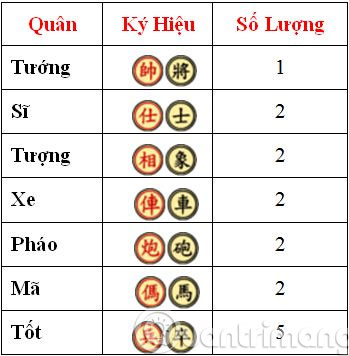
| Piece | Common red / black characters | Number per side |
|---|---|---|
| General or king | 帥 / 將 | 1 |
| Advisor or guard | 仕 / 士 | 2 |
| Elephant | 相 / 象 | 2 |
| Horse | 傌 or 馬 / 馬 | 2 |
| Chariot or rook | 俥 or 車 / 車 | 2 |
| Cannon | 炮 / 砲 or 炮 | 2 |
| Soldier or pawn | 兵 / 卒 | 5 |
How each piece moves
General
The general moves one point horizontally or vertically within its own palace. It cannot move diagonally or onto an attacked point. The two generals may never face each other along the same file with no piece between them. Moving their only intervening piece away is therefore illegal unless the resulting position still protects both generals from facing.
Advisor
The advisor moves one point diagonally along the palace markings and must remain in its own palace.
Elephant
The elephant moves exactly two points diagonally and cannot cross the river. A piece of either colour on the intervening diagonal point—the elephant's “eye”—blocks that move. The elephant cannot jump over it.
Horse
The horse's destination is two points along one axis and one along the other. Think of the move as one point straight, followed by one point diagonally. If the first straight point—the horse's “leg”—is occupied by either colour, the move in that direction is blocked.
For example, a piece directly in front of a horse blocks its two forward-reaching moves. It does not automatically block every move the horse could make.
Chariot
The chariot moves any distance horizontally or vertically along a clear line. It can capture an opposing piece at its destination but cannot pass through any occupied point.
Cannon
When moving without capturing, a cannon follows the chariot's rule: every point along its path must be empty. To capture, it must jump over exactly one intervening piece, called a screen, and land on the opposing piece. The screen may belong to either player and remains on the board.
No screen means no capture; two screens also prevent the capture. Do not count the captured piece itself as the screen.
Soldier
Before crossing the river, a soldier moves and captures one point straight forward. After crossing, it may also move or capture one point sideways. It can never move backward or diagonally and does not promote into another piece. At the far edge, it can still move sideways.
Captures, check and checkmate
A legal capture removes the opponent's piece and places your piece on its point. You cannot capture a friendly piece, and you cannot make any move that leaves your own general under attack.
Check means the general is threatened with capture. You must answer it immediately with a legal move. Depending on the position, you may move the general, capture the attacker, block a line attack, or change the piece blocking a horse or screening a cannon.
Blocking does not work against every attack. For example, placing an extra screen in a cannon's line can stop a cannon check, while placing the only screen there can create one. Always examine the resulting position.
Checkmate means the general is in check and no legal move removes the threat. The checked side loses. Stalemate means the player to move has no legal move but is not in check; in Xiangqi, that player also loses.
Draws and competition rules
Players may agree to a draw, and rule sets also provide procedures for positions with no winning progress. Repetition is more complicated than simply repeating any position three times: continuous checking and certain repeated chases can require the responsible player to change their moves or lose.
For timed games, tournament penalties, move counts and repetition disputes, use the event's regulations and the World Xiangqi Federation rulebook. Do not apply an unexplained fixed move limit to every casual game.
Practice your first game
Before each move, check the destination, the horse's leg or elephant's eye where relevant, the cannon's screen, and the line between the generals. Start with untimed games so you can explain captures and checks to each other. Once these rules are familiar, practise developing your chariots and horses while keeping your general protected.





Reader Comments 0
Sign in with email or Google to join the discussion.