Table of Contents
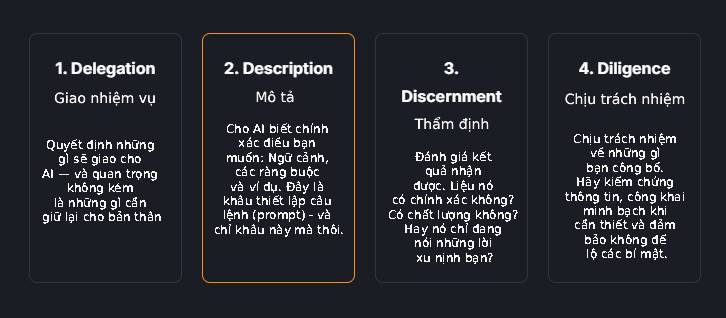
Writing a good prompt is useful, but working well with AI also requires choosing the right task, checking the answer, and owning the result. The AI Fluency Framework, developed by Rick Dakan and Joseph Feller in collaboration with Anthropic, describes these habits as four connected competencies: Delegation, Description, Discernment, and Diligence.
What the four Ds mean in daily work
- Delegation: decide what an AI tool should do, what a person must do, and where review is needed.
- Description: give the tool a clear goal, relevant source material, constraints, and an output format.
- Discernment: evaluate the output against evidence and the actual task, then revise or reject it.
- Diligence: protect data, follow applicable policies, disclose AI involvement when required, and remain accountable for the work.
These competencies reinforce each other. A clear prompt cannot make an inappropriate task safe to delegate. A polished answer still needs checking. Good verification does not excuse sharing confidential material with an unapproved service.
1. Delegation: choose a bounded task
Start with a task that is reversible and easy to review: draft an outline, organize notes you are allowed to share, or suggest alternative headings. Keep final decisions with a person when a mistake could affect someone's money, safety, rights, or access. Define which source the tool may use and when a reviewer should stop the process. TipsMake has a practical guide to choosing suitable AI tasks.
2. Description: give a useful brief
For an approved task, describe the goal and audience, paste the relevant material, name hard constraints, and state what a good answer must include. Example: “Turn these approved meeting notes into a five-bullet update for the project team. Use only facts in the notes. Mark missing dates as ‘not stated.’ Do not send it.” The last sentence keeps drafting separate from publication.
3. Discernment: test the output
Check names, dates, numbers, and quotations against the original records. Ask whether the answer actually serves the reader and whether it omitted a caveat. If the model supplies a citation, open it and compare the claim with the source. A useful review log can mark each factual claim as supported, contradicted, or unresolved. See TipsMake's factual claim verification workflow.
4. Diligence: own the final action
Remove unnecessary personal or confidential data before prompting. Follow your organization's rules for approved tools and review. If a public deliverable needs disclosure or attribution, provide it. A person who is authorized to make the decision should sign off on consequential content or actions. Keep a record of what the tool drafted and what a person checked.
Build a small example of your own
- Choose one recurring, low-risk task you already understand.
- Write one sentence explaining why AI is suitable for a limited part of it.
- Draft the prompt with source material, constraints, and output format.
- List three checks you will perform on the result.
- Record the final human decision: use, revise, or discard.
That one-page record demonstrates more than a claim that you “know AI.” It shows where AI helped, where it failed, and how you handled the result. Do not use a model's self-awarded score as proof of your own skill; judge the actual workflow.
Check your understanding
-
Question 1:
Why is it better to assess AI fluency through observed habits than self-confidence alone?
EXPLAIN:
A person can feel proficient without checking outputs or protecting data. Concrete examples of work reveal what was actually done and where the process needs improvement.
-
Question 2:
Which four competencies make up the 4D AI Fluency Framework?
EXPLAIN:
The "4 D's" theoretical framework – Delegation, Description, Discernment, and Diligence – was developed by Professors Rick Dakan and Joseph Feller in collaboration with Anthropic. Each skill is a separate component that you can practice and improve; this course will focus on one skill in each lesson.
-
Question 3:
In this course's approach, what role does the skill of writing prompts play?
EXPLAIN:
Prompt writing belongs to Description. The framework does not assign numerical weights to the four competencies; selecting tasks, evaluating results, and handling responsibility also matter.
Related Articles
 26 Things You Need to Master to Be Able to Survive in Modern Life13 minutes read
 6 Months for 8 Skills and Life You Will Change9 minutes read
 The AI Skills Gap: What Should Businesses Prepare for in 2026?8 minutes read
 Coin Master Pets and Things to Know4 minutes read
 Coin Master Tips: 18 Legit Ways to Progress Faster15 minutes read
 Execute Shell Script in Linux: Step-by-Step Guide7 minutes read
Reader Comments 0
Sign in with email or Google to join the discussion.