What you will learn
- Separate factual claims from opinions and suggestions.
- Prioritize high-impact claims for verification.
- Use primary and independent authoritative sources.
- Record verified, contradicted and unresolved claims before using the output.
What you need
- An AI-generated answer containing factual statements.
- Access to official documentation, original datasets or other authoritative sources.
- A notes table or spreadsheet for recording evidence.
Treat confidence and accuracy as separate things
OpenAI states that ChatGPT can produce incorrect definitions, dates, facts, quotations and references, sometimes with confident language. Important information should be verified with reliable sources.
OpenAI research describes hallucinations as plausible but false statements and notes that they remain a challenge even as model accuracy improves.
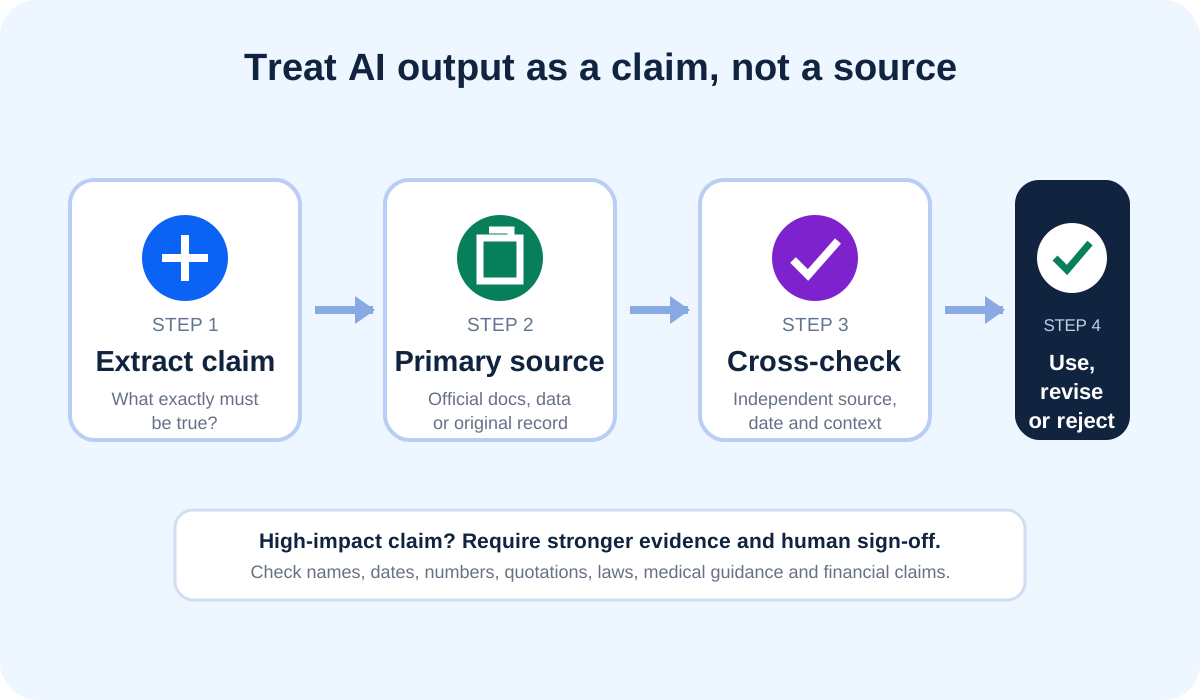
Step 1: Extract atomic claims
Break complex sentences into statements that can be true, false or uncertain. “The policy changed in June and applies to all customers” contains at least two claims: the date and the scope.
- 1
Copy the answer into a working document; do not edit it yet.
- 2
Highlight dates, names, numbers, definitions, legal requirements, product capabilities, quotations and source references.
- 3
Split combined statements into one claim per row.
- 4
Label each claim high, medium or low impact based on the harm caused if it is wrong.
- 5
Verify high-impact claims first, especially medical, legal, financial, security and current-event claims.
Step 2: Find the closest primary source
A primary source is the organization, document, dataset or person directly responsible for the information. Examples include official product documentation, legislation, regulatory notices, research papers, release notes and original datasets.
- 1
Search the exact claim terms plus the responsible organization.
- 2
Prefer the current official document over a blog summarizing it.
- 3
Check the publication date, update date, version and jurisdiction.
- 4
Open the cited source rather than trusting the title or search snippet.
- 5
For controversial or high-impact claims, find a second independent authoritative source.
Step 3: Compare meaning—not just keywords
A source can contain the same words while supporting a narrower claim. Watch for qualifiers such as may, generally, supported versions, eligible users, preliminary and subject to change.
- 1
Copy the exact evidence passage into your notes using a short quotation or paraphrase.
- 2
Record the source title, publisher, URL and date accessed.
- 3
Compare date, population, conditions, units and exceptions with the AI claim.
- 4
Mark the claim Verified, Partly supported, Contradicted or Unresolved.
- 5
Rewrite the final statement to match the evidence and preserve uncertainty.
- Every high-impact claim has evidence.
- Every citation opens and supports the nearby statement.
- Dates and versions match the user’s context.
- Unresolved claims are removed or clearly labeled.
Step 4: Check quotations and citations separately
Invented references are especially dangerous because they create the appearance of evidence. Search the title, author and publication independently. If the document cannot be found, do not keep the citation simply because it looks plausible.
Step 5: Decide how the verified output may be used
Low-risk brainstorming can tolerate uncertainty. A public article, client recommendation, security instruction or financial decision needs stricter evidence and human review. Set the verification standard based on impact, not convenience.
Build a five-claim verification table
Use an AI answer on a topic you understand well enough to judge the sources.
- 1
Extract five factual claims.
- 2
Assign an impact level.
- 3
Find a primary source for each claim.
- 4
Record supporting evidence and access date.
- 5
Mark each claim verified, partly supported, contradicted or unresolved.
- 6
Rewrite the answer using only supported claims.
Common mistakes to avoid
- Treating a confident tone as evidence.
- Citing a search snippet without opening the source.
- Using several websites that all repeat the same unsupported claim.
- Keeping a fabricated citation because the rest of the answer appears correct.
Key takeaways
- Verify claims individually, beginning with the highest-impact statements.
- Primary sources and current versions matter.
- A citation is useful only when it opens and supports the nearby claim.
Frequently asked questions
Can AI search tools replace verification?
They can help locate sources, but you still need to open the sources and compare what they actually support.
Do I need two sources for every claim?
Not always. One strong primary source may be enough for a straightforward product fact; high-impact or disputed claims deserve independent confirmation.
Sources and further reading
- Does ChatGPT tell the truth?OpenAI Help Center
- Why language models hallucinateOpenAI
Ready to continue?
Mark the lesson complete so your Learning Path progress stays current on this device.