Table of Contents
AI recruiting tools are most useful when they solve a specific bottleneck: finding candidates, screening a large applicant pool, capturing interview evidence, or keeping applicants moving through scheduling. The five platforms below cover different parts of that process, so the best choice depends on where your team is losing time.
AI recruiting tools at a glance
| Tool | Best suited to | Main role in the hiring process |
|---|---|---|
| Hivemind | Teams seeking one connected hiring workflow | Applicant tracking, assessments, communication, scheduling, and interviews |
| HireVue | Structured, high-volume screening | On-demand video interviews and job-related assessments |
| Juicebox | Proactive candidate sourcing | Natural-language people search and outreach |
| Metaview | Interview documentation and consistency | Transcripts, structured notes, and recruiting workflow support |
| Paradox | High-volume applicant communication | Conversational screening, questions, applications, and scheduling |
Product capabilities and integrations change, so verify the current plan, supported countries, data-handling terms, and ATS compatibility before committing.
Hivemind: a unified recruiting workflow
Hivemind positions itself as a recruiting operating system rather than a single-purpose add-on. Its workflow spans applicant tracking, candidate communication, assessments, scheduling, interviews, and reporting.
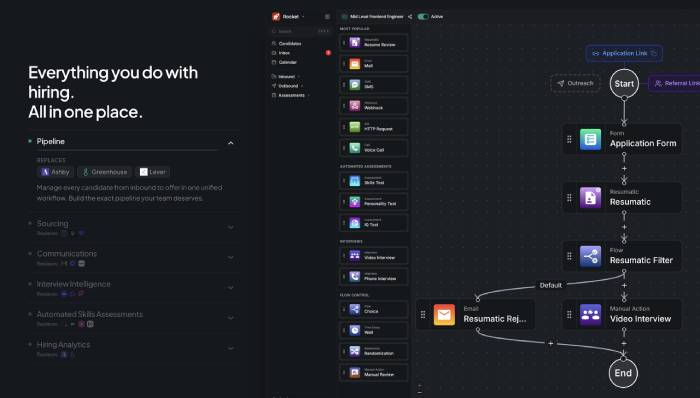
This breadth can appeal to a team trying to replace a collection of disconnected tools. It also makes evaluation more involved: test how existing candidate records migrate, whether essential integrations are available, how automated decisions can be reviewed, and whether the system supports the team's approval process. A broad platform is only an advantage if its individual workflows match how the organization hires.
HireVue: structured video interviews and assessments
HireVue is designed for structured screening at scale. Employers can give candidates the same on-demand video questions and use job-related criteria or assessments to evaluate responses more consistently.
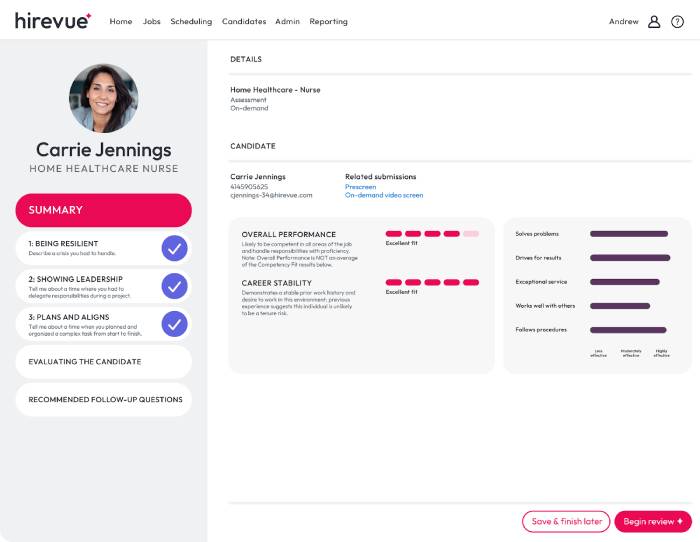
It is a practical fit for early-career programs and other roles that attract many applicants. The trade-off is scope: HireVue may handle screening and assessment while the ATS remains the system of record. Before deployment, review which assessments are used, how scores are explained, what accommodations are available, how long recordings are retained, and where a human reviewer enters the process.
Juicebox: natural-language candidate sourcing
Juicebox, whose search product is known as PeopleGPT, lets recruiters describe a target profile in ordinary language instead of relying only on complex Boolean queries. It brings together public professional information to help users find candidates, research profiles, and organize outreach.
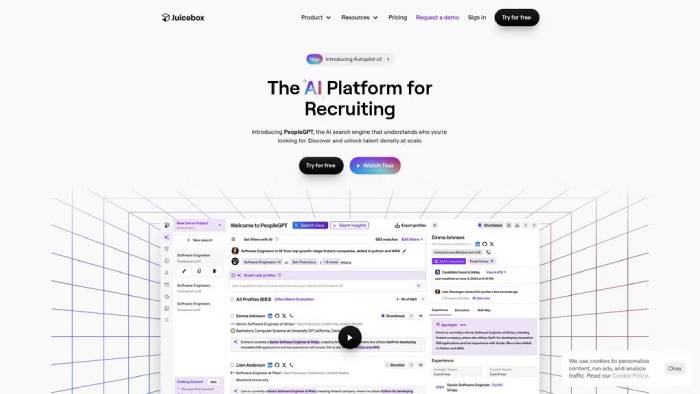
The tool is strongest near the top of the funnel. A search result still needs human validation: confirm experience against the source profile, check location and work-authorization requirements, remove proxies for protected characteristics, and personalize outreach. Finding a plausible profile does not establish interest in the role or suitability for it.
Metaview: structured interview notes
Metaview can capture recruiting conversations and turn them into transcripts and structured notes. This reduces the need to type continuously during an interview and gives the hiring team a shared record for scorecards and debriefs.
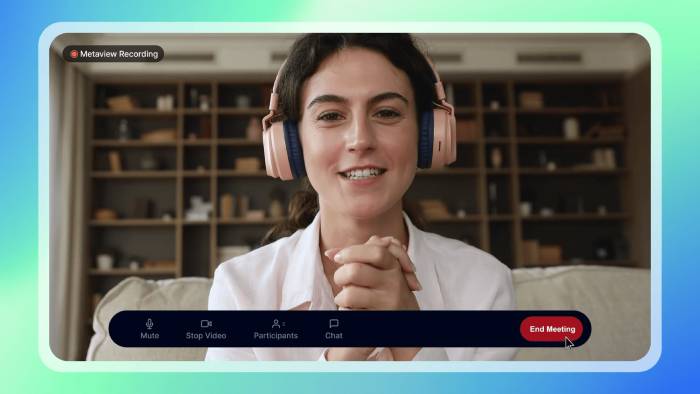
Good notes do not fix a weak interview design. Define competencies and scoring criteria first, ask the same core questions of comparable candidates, and require interviewers to verify the generated notes before submitting feedback. Candidates should also be told when a conversation is recorded and how the recording will be used.
Paradox Olivia: candidate communication and scheduling
Paradox uses its conversational assistant, Olivia, to answer common applicant questions, collect initial information, support applications, screen for defined requirements, and schedule interviews.
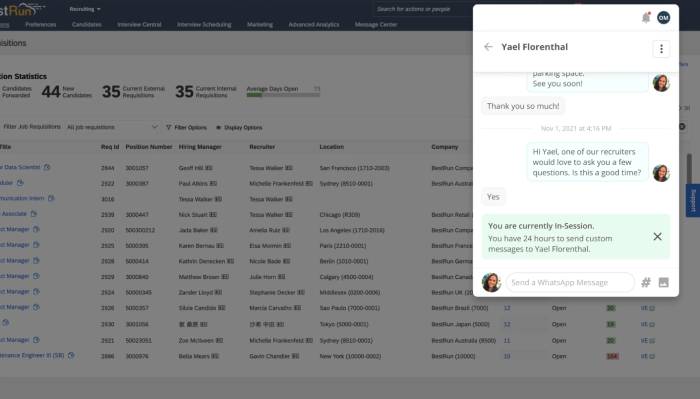
This can reduce administrative work in high-volume hiring, particularly when applicants expect a quick mobile response. Check that the conversation can hand off to a person, that screening rules are job-related, and that applicants are not trapped by a chatbot when they need an accommodation or have a question outside the scripted flow.
How to choose an AI recruiting platform
Start with one measurable problem rather than buying the tool with the longest feature list:
- Too few qualified prospects: test a sourcing platform such as Juicebox.
- Too many first-round interviews to coordinate: compare HireVue's structured screening with your current process.
- Incomplete or inconsistent interview evidence: pilot Metaview with a defined scorecard.
- Applicants wait too long for answers or scheduling: evaluate Paradox and its human handoff.
- Data is fragmented across many systems: assess whether Hivemind can replace the required workflows and integrations.
Run a limited pilot using representative roles and track concrete outcomes such as recruiter time, candidate completion, response speed, and the rate of human corrections. Include recruiters, hiring managers, legal or privacy staff, and accessibility stakeholders in the review.
Keep humans accountable for hiring decisions
AI can organize information and automate routine steps, but it should not become an unexamined gatekeeper. Document what each system evaluates, audit results for inconsistent treatment, provide a route for accommodation and appeal, and keep a qualified person responsible for the final decision. Local rules on notice, consent, automated employment decisions, and retention may also apply.
Related Articles
 This Is the 6 Reasons Why Your Company Still Can't Recruit Talented8 minutes read
 7 Incredible Benefits of Using AI in Employees' Recruitment6 minutes read
 How to Make a Recruitment Form with Excel Quickly4 minutes read
 Google, Apple and Many Other Large Companies Employing Employees No Longer Require a College Degree5 minutes read
 Top Job Search Website, the Most Prestigious Recruitment Website9 minutes read
 Should Recruiting People Who Have Left the Company and Then Want7 minutes read
Reader Comments 0
Sign in with email or Google to join the discussion.