Table of Contents
We do not know whether the entire universe is finite or infinite. We can observe only a limited region, and evidence that space is expanding does not settle its total size. A finite observable universe is not the same thing as a finite universe.
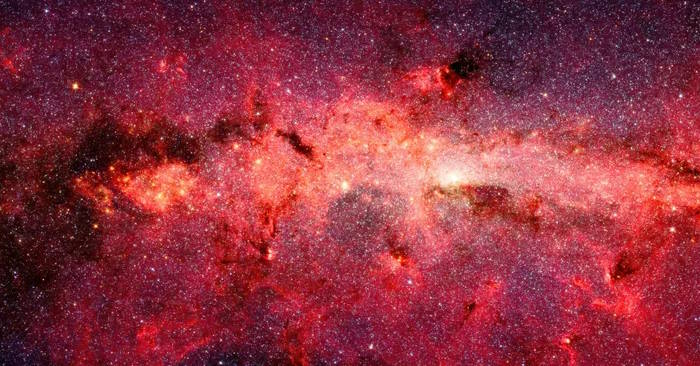
The observable universe has a horizon
Light travels at a finite speed, and the universe has a finite age. We can receive information only from regions whose signals have had time to reach us. That gives us an observational horizon, not a physical wall at the end of space.
An observer far away would have a different observable region centered on their location. Our position at the center of our observable region therefore does not make Earth the center of the whole universe.
NASA's explanation of space's size distinguishes what can be observed from the unresolved question of whether all space is infinite.
What expansion means
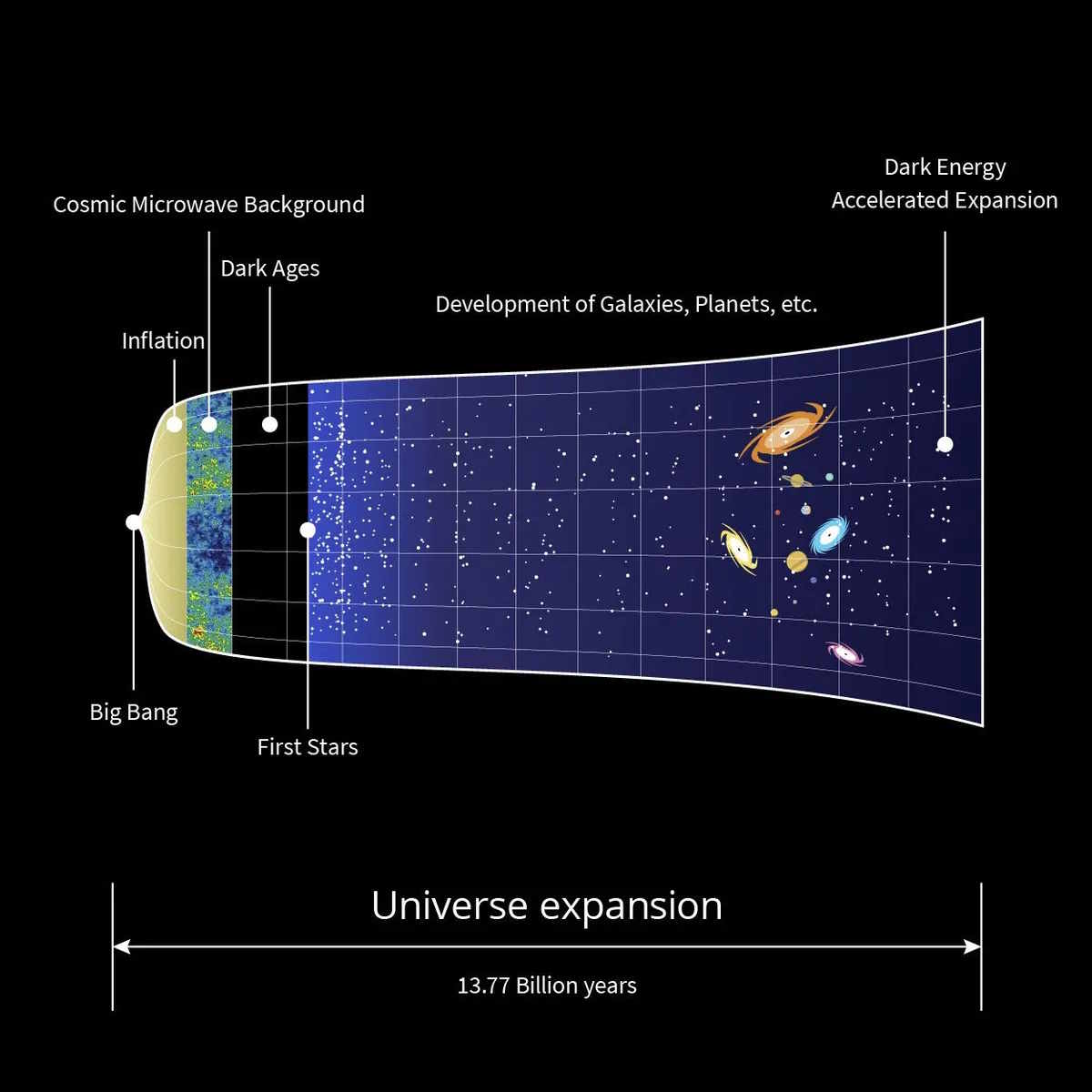
In standard cosmology, distances between sufficiently separated, unbound regions increase as the scale of space changes. The Big Bang model describes an early hot, dense state and subsequent expansion; it is not an explosion from one location into pre-existing empty space.
This does not mean every object expands with the universe. Gravitationally bound systems and objects held together by other forces do not simply grow in step with cosmic expansion.
Why the balloon analogy needs care
Imagine dots on the surface of an inflating balloon. As the surface grows, each dot sees others moving away. For the analogy, only the two-dimensional surface represents space. The center inside the balloon and the surrounding room are not parts of that represented universe.
A raisin loaf can also illustrate increasing separation, but its crust and oven are misleading if taken literally. Analogies show one relationship; they do not establish a boundary, an outside region, or the universe's actual shape.
Finite does not necessarily mean an edge
A sphere's surface has finite area but no boundary: traveling along it does not bring you to a rim. This is a lower-dimensional illustration, not a claim that the universe is a sphere embedded in an accessible surrounding space.
Geometry and topology are different questions. Even a spatially flat universe can have different global possibilities. ESA's discussion of finite and infinite models explains why flatness alone does not prove infinity.
What is the universe expanding into?
The standard expansion model does not require a surrounding container. It describes changing distances within space itself. Speculating about a larger setting is different from having observational evidence for one.
The careful conclusion is therefore limited: the universe is expanding, our observations cover a finite region, and the total extent of space remains unknown. Neither a balloon picture nor the definition of “universe” is a substitute for measuring its global structure.
Related Articles
 How to create Naruto in Infinite Craft, a character in the Naruto universe
 What is Infinite Scrolling and how does it work?
 How to Implement Infinite Scrolling in Vue
 Infinite Galaxy game tips for newbies
 Official Torchlight Infinite launch date
 MSI launches new gaming desktop series with powerful configuration and impressive design
Reader Comments 0
Sign in with email or Google to join the discussion.