Table of Contents
Researchers reported heating a thin gold sample to about 19,000 kelvin—roughly 18,700°C—while it briefly retained crystalline structure. The crucial word is briefly: this was an ultrafast laboratory experiment, not a gold object remaining solid indefinitely in an extremely hot furnace.
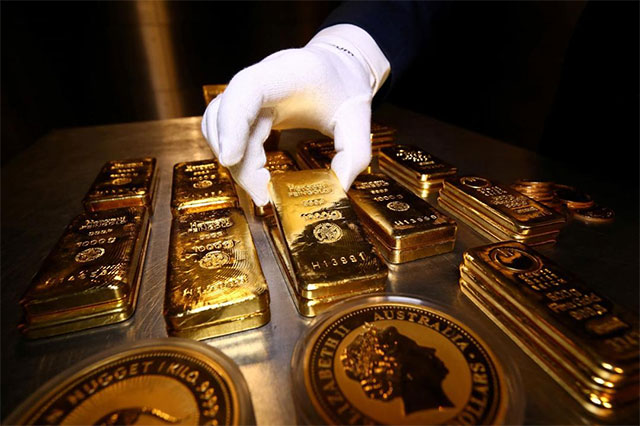
What the experiment measured
The study Superheating gold beyond the predicted entropy catastrophe threshold appeared in Nature on July 23, 2025. The team used rapid laser heating and high-resolution inelastic X-ray scattering at SLAC's Linac Coherent Light Source.
Changes in the scattered X-rays allowed the researchers to determine ion-motion distributions and infer lattice temperature. Structural measurements showed crystalline order during the short observation window. Temperature and structure are separate parts of the evidence.
Why a solid can exceed its normal melting point
A familiar melting point describes a material under specified conditions near equilibrium. When energy is deposited extremely quickly, the material may not have time to expand or complete the changes needed to become liquid before it is measured.
The authors identify the limited time for expansion as an important difference from earlier stability estimates. This does not mean ordinary gold jewelry has acquired a new melting point.
What the theoretical challenge means
The experiment surpassed a proposed superheating threshold associated with an “entropy catastrophe.” According to SLAC's explanation, the result suggests that much greater superheating may be possible under sufficiently rapid heating.
It does not violate the second law of thermodynamics. Nor does one material and experimental setup establish that every solid can withstand arbitrarily high temperatures. The reported ratio of more than 14 times the melting temperature uses the absolute kelvin scale, not a comparison of Celsius numbers.
Why the measurement method matters
Researchers studying dense, hot matter need reliable temperature information to compare experiments with models. Better measurements can support work on planetary interiors and fusion-related materials, where the conditions exist for very short times.
The practical advance is a method for probing those conditions and a specific result about transient superheating. It is not evidence of a durable heat-proof material or a ready-to-use fusion technology.
Related Articles
 '3D time' - new concept could be key to 'theory of everything'
 Turn copper into a material that closely resembles gold
 Do you know: How many kilograms does 1 tael of gold weigh? What is an ounce of gold?
 Did you know: how many kilograms does a gold tree (gold) weigh?
 Thanks to the broken antenna, the scientists solved the 58-year secret of physics
 The 9 biggest mysteries of modern physics make scientists headaches (Part 2)
Reader Comments 0
Sign in with email or Google to join the discussion.