Table of Contents
Backed by OpenAI , startup Merge Labs is ambitious to change the way humans interact with computers. Instead of using invasive electrodes like Neuralink , the company opts for ultrasound to read and regulate brain activity.
1. What is Merge Labs?
Merge Labs is a for-profit research lab that spun off from the non-profit organization Forest Neurotech . What made this company stand out was its $252 million investment , with the involvement of Sam Altman (CEO of OpenAI).
The founding team includes leading experts in Brain-Computer Interfaces (BCI) such as Tyson Aflalo, Sumner Norman, and Mikhail Shapiro from the California Institute of Technology (Caltech).
2. Ultrasound technology: Minimally invasive but effective over a wide area.
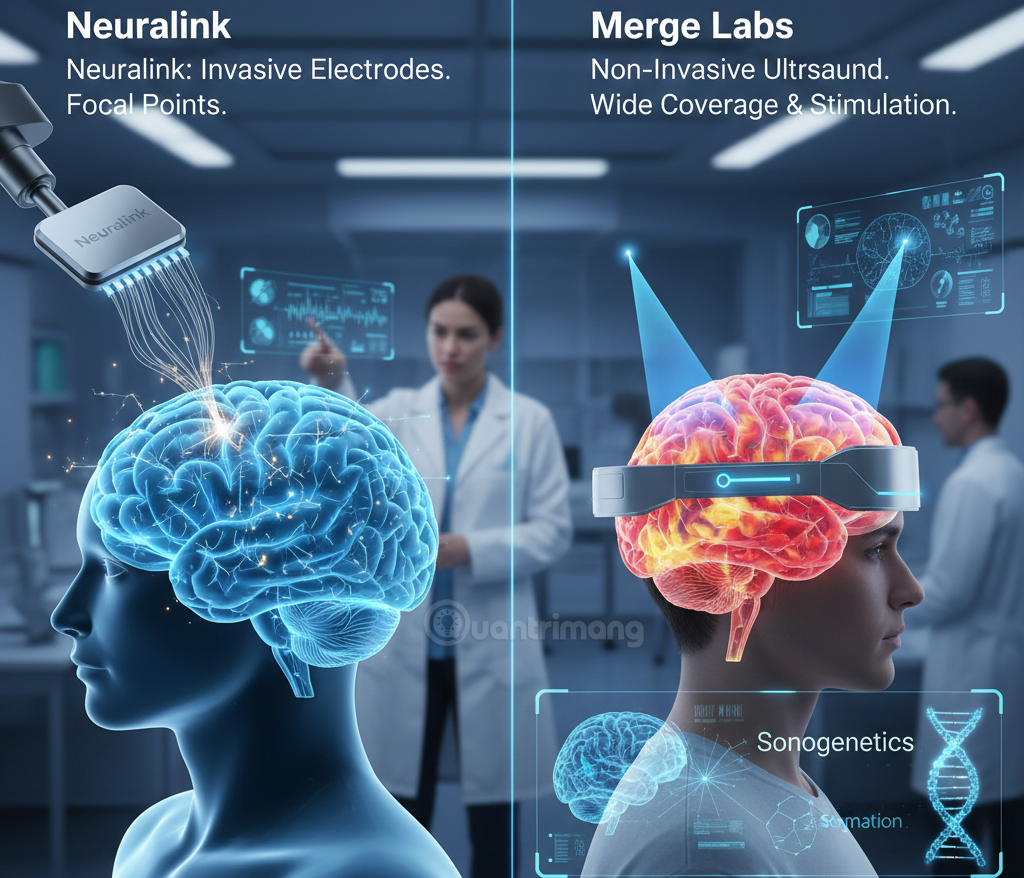
The biggest difference between Merge Labs and Neuralink (Elon Musk's company) lies in their approach:
- Neuralink: Implants electrode fibers deep into brain tissue to measure electrical activity.
- Merge Labs: Uses high-frequency ultrasound waves delivered through sensors placed under the skull or through a small "window" in the bone.
According to neurologist Elsa Fouragnan (University of Plymouth), ultrasound waves can cover a large area of the brain and stimulate multiple locations simultaneously. This helps treat complex mental disorders such as depression instead of focusing on a single point.
3. Mechanism of Operation: From Images to Neuro-Control

Merge Labs' process is based on two core principles:
Blood flow analysis (Functional Ultrasound)
When neurons are highly active, they require more oxygen, leading to changes in local blood flow. Ultrasound waves analyze the frequency and amplitude of the waves reflected from moving blood cells to create a map of brain activity.
Neurostimulation and Sonogenetics
By focusing multiple ultrasound beams onto a single point, the pressure alters the reaction speed of neurons. Merge Labs is also exploring sonogenetics – a genetic engineering technique that helps specific cells respond more sensitively to sound waves.
4. Scientific Challenges and Limitations

Despite its potential, this technology still faces significant hurdles:
- Time lag: Measuring blood flow is an indirect indicator and lags behind the brain's instantaneous electrical activity. This makes real-time communication difficult, such as decoding language.
- Surgery is still required: Although less invasive, this method still requires surgery to place the device under the patient's skull.
5. Potential for practical applications
Although still in its early stages, Merge Labs researchers have succeeded in:
- Decoding the locomotion intentions in primates.
- Brain activity was detected when people played the guitar or played video games.
In the future, this device could become a versatile treatment method for conditions such as epilepsy, tinnitus, addiction, and eating disorders without the need to place electrodes deep into the brain.
Related Articles
 Successfully Decipher Complex Thoughts in the Human Brain4 minutes read
 Artificial Intelligence Algorithms Read Human Thoughts: What to Know5 minutes read
 New AI Can 'read Human Behavior' with Unprecedented Accuracy5 minutes read
 OpenAI Could Launch Its First AI Chip in 20264 minutes read
 Everything You Need to Know About Openai7 minutes read
 Technology Can Help People with Supernatural Abilities 'Read Thoughts, Telepathy'?4 minutes read
Reader Comments 0
Sign in with email or Google to join the discussion.