Table of Contents
This article examines 5 Strange Creatures Than Even Science Fiction Novels. It presents the main facts, practical implications, and key points in a clearer, easier-to-follow format.
After three weeks of exploration in the Pacific waters of Samoa, the biologists of the US National and Atmospheric Administration, NOAA, have discovered several forms of life not previously recorded in depth. 4km. Among them is an extremely special fish, it seems to use the legs to walk under the sea.
Besides, they also found dozens of other species such as sea lilies, starfish, corals, mollusks of animals, jellyfish. They all have very special shapes and most likely creatures for the first time. to be seen.
Biologists have explored three different marine reserves: Samoa National Marine Reserve, American Samoa National Park and Rose Atoll National Reserve.
Here are the 5 most special creatures discovered in this expedition.
5. Rainbow Jellyfish - Rainbow Ctenophore

This strange living creature was discovered in an active volcano under the Vailulu Sea of the Pacific Ocean.
The sparkle of rainbow colors in the jellyfish body is actually not glowing, they are just furry rows. When encountering waves, they refract light like the colors of a rainbow. These rows of feathered feathers glow in the dark when the jellyfish moves in the water.
4. Fly-kneeling Venus - Venus Flytrap Anemone
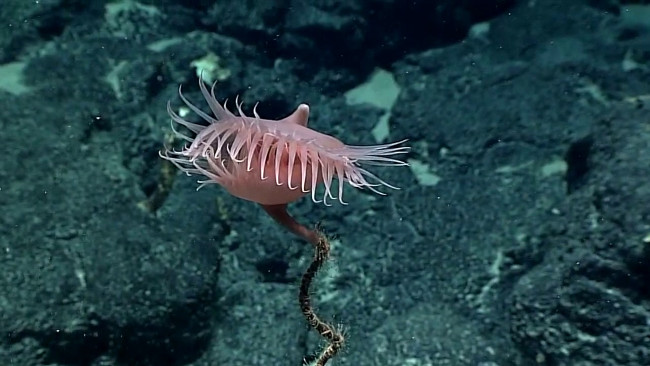
These strange creatures use sharp tentacles attached to tiny venom-filled hooks to inject into prey when they are trapped in a beautiful pink trap similar to a fly-on-earth trap.
3. Cosmic Jellyfish - Cosmic Jellyfish
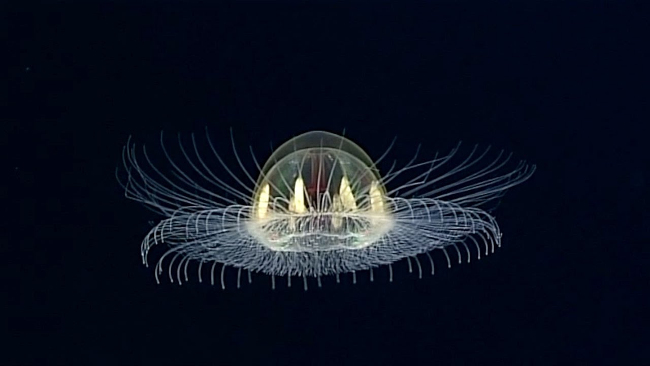
This colorful jellyfish belongs to the Rhopalonematidae family, which has gonads attached to separate tubes running along the body.
This jellyfish was found by biologists at a depth of 3,000 meters in the Utu gorge of Samoa National Marine Reserve. At that time, the jellyfish seemed motionless and was waiting for food.
2. Hydroid with an Unfortunate Head - Hydroid with an Unfortunate 'Head'
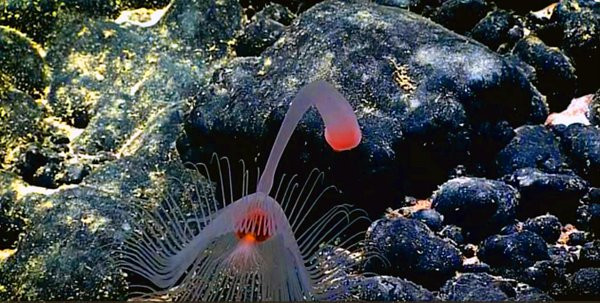
A solitary aquatic creature was found at a depth of 3,770 m when biologists explored the mountain area of Leoso, located between the boundary of the EEZ and the Cook Islands.
1. Crested Salmon Fish with Legs
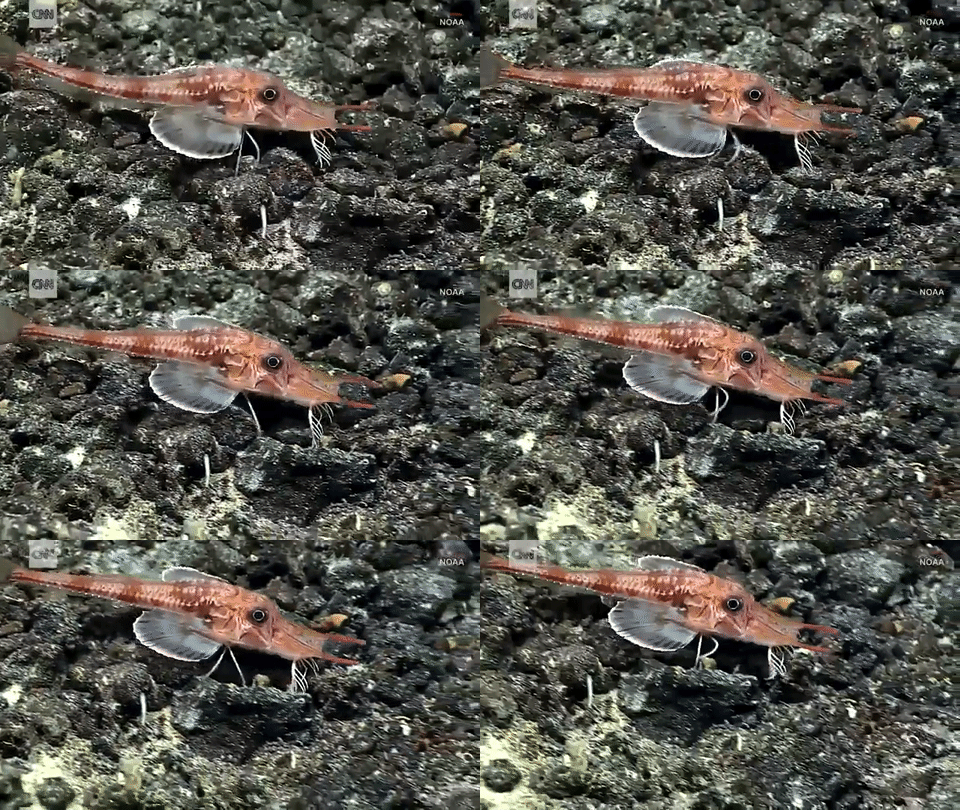
This crested salmon fish is the group's favorite discovery. This creature is extremely special, not only because it looks almost like walking with two small legs but also two "horns" in front of its mouth.
- The first images of the mysterious ghost shark at a depth of 2,000m.
- Listed 10 largest species of creatures in the ocean.
FAQ
What is the main point of 5 Strange Creatures Than Even Science Fiction Novels?
After three weeks of exploration in the Pacific waters of Samoa, the biologists of the US National and Atmospheric Administration, NOAA, have discovered several forms of life not previously recorded in depth. Among them is an extremely special fish, it seems to use the legs to.
Why is 5 Strange Creatures Than Even Science Fiction Novels important?
5 Strange Creatures Than Even Science Fiction Novels matters because it can affect how readers understand, choose, use, or respond to the subject discussed in the article.
What should readers verify about 5 Strange Creatures Than Even Science Fiction Novels?
Check the date, product or software version, compatibility, and any current guidance before acting, especially when technology, security, health, or pricing is involved.
Related Articles
 Strange Creatures Hide Deep in the Ocean Floor9 minutes read
 10 Strange Creatures Found in the Deep Sea in 20219 minutes read
 7 Alien Planet Is More Exotic Than Science Fiction Movies5 minutes read
 Mysterious Creatures Dance Strange Dance When Someone Touches It3 minutes read
 Download 40 Beautiful Sci-fi Fonts for Design, Absolutely Free3 minutes read
 Who Would Have Expected These Strange Creatures to Live with Humans4 minutes read
Reader Comments 0
Sign in with email or Google to join the discussion.