Table of Contents
Convert Data Type in C #: Convert Data Types in C # is easier to understand when the core ideas are paired with practical examples. The sections below explain the topic clearly, highlight useful steps, and point out details that can prevent common errors.
Converting data types in C # is to convert one data type to another. It is also known as Type Injection. In C #, type casting has the following two patterns:
Implicit conversion (implicit) - This conversion is done by C # in a type-safe method. For instance,, conversion from inheriting classes to base classes.
Explicit conversion (explicit) - This conversion is explicitly performed by the user using predefined functions. Explicit type conversions need a cast operator.
the example below illustrates an explicit transformation in C #:
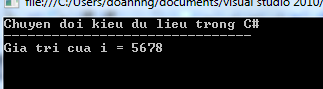
using System ; namespace QTMCsharp { class TestCsharp { static void Main ( string [] args ) { Console . WriteLine ( "Chuyen doi kieu du lieu trong C#" ); Console . WriteLine ( "-------------------------------" ); double d = 5678.74 ; int i ; // cast kieu du lieu double thanh kieu du lieu int. i = ( int ) d ; Console . WriteLine ( "Gia tri cua i = " + i ); Console . ReadKey (); } } }
Compiling and running the above C # program will produce the following results:
Method to convert data types in C #
C # provides the available type conversion methods listed in the following table:
Convert a type to a Boolean value, if possible
ToByteConvert a type to a byte
ToCharConvert a style to a Unicode character, if possible
ToDateTimeConvert a type (integer or string) into date-time structures
ToDecimalConvert a real number or integer to a decimal type
ToDoubleConvert a type to a double type
Tont16Convert a style into a 16-bit integer
ToInt32Convert a style into a 32-bit integer
ToInt64Convert a style into a 64-bit integer
ToSbyteConvert a type to a signed byte type
ToSingleConvert a style to a number of small floating points
ToStringConvert a style to a string
ToTypeConvert a type to a specified type
ToUInt16Convert a type to an unsigned int type
ToUInt32Convert a type to an unsigned long type
ToUInt64Convert a type into an unsigned big integer
the example below illustrates how to convert diverse data types into string data types in C #:
using System ; namespace QTMCsharp { class TestCsharp { static void Main ( string [] args ) { Console . WriteLine ( "Chuyen doi kieu du lieu trong C#" ); Console . WriteLine ( "-------------------------------" ); int i = 75 ; float f = 53.005f ; double d = 2345.7652 ; bool b = true ; //su dung phuong thuc ToString() Console . WriteLine ( i . ToString ()); Console . WriteLine ( f . ToString ()); Console . WriteLine ( d . ToString ()); Console . WriteLine ( b . ToString ()); Console . ReadKey (); } } }
Next post: Array (Array) in C #
FAQ
What is Convert Data Type in C #: Convert Data Types in C #?
Converting data types in C # is to convert one data type to another.
Why is Convert Data Type in C #: Convert Data Types in C # important?
A clear understanding of Convert Data Type in C #: Convert Data Types in C # helps you make informed decisions, avoid common mistakes, and use the relevant tools or techniques more effectively.
How should beginners approach Convert Data Type in C #: Convert Data Types in C #?
Start with the fundamental concepts, follow the examples step by step, and test each change in a safe environment before applying it to important systems or data.
Related Articles
 MS SQL Server: Data Types in SQL Server6 minutes read
 Convert MBR to GPT with No Data Loss: Complete Guide2 minutes read
 How to Use Excel Vba Variable Data Types11 minutes read
 Convert in SQL Server Functions: CONVERT Function in SQL Server5 minutes read
 Number in C ++: Explained1 minutes read
 How to Convert Data from Columns to Rows in Excel Is4 minutes read
Reader Comments 0
Sign in with email or Google to join the discussion.