What you will learn
- Convert a broad topic into answerable subquestions.
- Map claims to evidence and source types.
- Use AI to plan and synthesize without hiding source gaps.
- Create an evidence log before drafting conclusions.
What you need
- A research question tied to a decision or deliverable.
- Access to web search, databases or original documents.
Start with the decision the research must support
OpenAI’s deep research workflow begins with a described outcome, selectable sources and a proposed research plan that the user can review before research starts.
NIST’s AI RMF frames risk management around context, measurement, governance and management—useful reminders that a research output must be evaluated in its intended use.
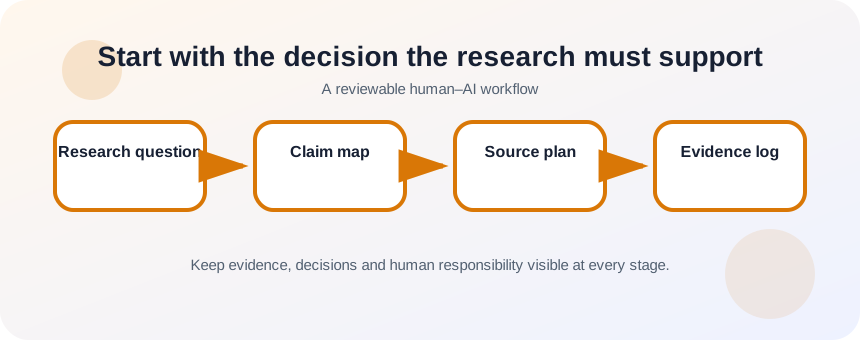
A report for choosing software needs different evidence from an academic overview or a customer FAQ. Write the decision, audience, geography, date range and exclusions. This prevents the research from expanding until it becomes a generic encyclopedia.
Build a claim and evidence map
Break the main question into descriptive, comparative and causal subquestions. Then name the strongest source type for each. Official release notes can establish a product feature. A regulator establishes a rule. An original dataset supports a market statistic. Independent testing may compare performance. One source type rarely answers every claim.
- 1
Write the decision and audience.
- 2
Define geography, date range and key terms.
- 3
List five to eight subquestions.
- 4
Convert expected answers into provisional claims.
- 5
Assign a preferred source type to each claim.
- 6
Mark claims that need two independent sources.
Use AI to organize, not erase, the evidence trail
Ask AI to propose missing subquestions, synonyms and source categories. Review the plan before searching. During research, store the source title, publisher, date, URL, evidence passage and the claim it supports. Draft only after the evidence map shows which claims are verified, disputed or unresolved.
- 1
Ask AI to critique the subquestion list.
- 2
Remove questions outside scope.
- 3
Search primary sources first.
- 4
Record evidence in a claim-by-claim table.
- 5
Add independent sources for consequential claims.
- 6
Mark contradictions and missing data.
- 7
Create an outline that reflects evidence strength.
Review coverage before writing prose
Check whether every major section has evidence, whether the sources are current enough and whether the plan included counterevidence. If important claims remain unresolved, change the report goal or state the limitation. Do not let AI fill an empty evidence cell with a plausible sentence.
- The question has a defined decision, scope and date range.
- Each important claim names the evidence required.
- Unresolved claims remain visible in the outline.
Plan a five-source research brief
Create a research plan without writing the final report.
- 1
Choose a decision-focused topic.
- 2
Write scope and exclusions.
- 3
Create six subquestions.
- 4
Assign source types.
- 5
Find five primary or authoritative sources.
- 6
Build an evidence table and label gaps.
Common mistakes to avoid
- Starting with search terms before defining the decision.
- Using one secondary article for every claim.
- Allowing the model to invent evidence for a planned section.
- Writing conclusions before reviewing contradictions.
Key takeaways
- Research begins with a scoped decision and claim map.
- AI can expand and organize the plan, but evidence remains external.
- Coverage and uncertainty should be visible before drafting.
Frequently asked questions
When should I use deep research rather than normal chat?
Use a research workflow for multi-source, current or consequential questions where you need a documented report and inspectable sources.
How many sources are enough?
The answer depends on the number and consequence of claims. Source quality, independence and direct support matter more than a fixed count.
Sources and further reading
- Deep research in ChatGPTOpenAI Help Center
- AI Risk Management FrameworkNIST
Ready to continue?
Mark the lesson complete so your Learning Path progress stays current on this device.