What you will learn
- Normalize competing claims before comparison.
- Inspect methodology, scope, date and incentives.
- Distinguish contradiction from different definitions.
- Write a conclusion with calibrated confidence.
What you need
- At least two sources addressing a similar question.
- Access to the original documents, not only snippets.
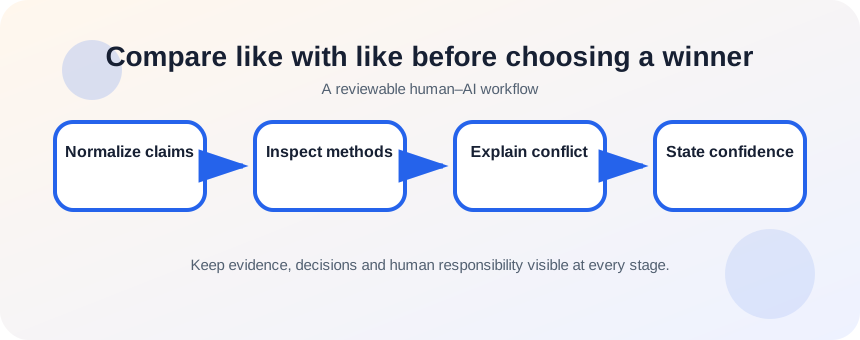
Compare like with like before choosing a winner
OpenAI’s deep research feature is designed to synthesize across multiple sources while providing citations or source links that users can inspect.
OpenAI also cautions that generated responses can misrepresent the weight of evidence or oversimplify nuanced disagreements.
Before comparing numbers, normalize the unit, time period, geography, population and definition. A survey of customers is not directly comparable with a count of all residents. Revenue is not profit. “Users” may mean accounts, monthly active users or paying subscribers.
Create a source comparison table
Give each source a row and each comparison dimension a column: publisher, date, primary question, data, method, sample, definition, limitation and claim supported. This structure makes hidden differences visible and prevents reputation alone from deciding the result.
- 1
Open the full source.
- 2
Record publisher and publication date.
- 3
Copy the exact claim being compared.
- 4
Record definitions and units.
- 5
Describe data collection or methodology.
- 6
Note funding, purpose and stated limitations.
Diagnose the reason for disagreement
A disagreement may be temporal, methodological, definitional, contextual or genuinely unresolved. Ask AI to summarize each source separately before asking for synthesis. Then compare the summaries against the originals. Do not ask for a single average when the underlying measures are incompatible.
- 1
Restate each claim in neutral language.
- 2
Convert units where valid.
- 3
Align or explicitly separate date ranges.
- 4
Identify different definitions.
- 5
Compare sample and method quality.
- 6
Look for newer evidence or corrections.
- 7
Classify the disagreement and write both positions.
Write a conclusion that reflects evidence strength
State what is agreed, what differs and why. Use confidence language tied to evidence: strongly supported, supported with limitations, mixed or unresolved. If one source is more relevant to the user’s context, explain that choice rather than declaring it universally superior.
Source disagreement is often explained by scope rather than dishonesty. Two reports may study different countries, populations, time periods or definitions while using the same headline term. Build a comparison table for publication date, author, method, sample, unit, exclusions and stated limitations before asking AI to summarize the conflict. The table exposes whether the sources truly contradict each other or answer different questions.
- Compared claims use compatible definitions or differences are explicit.
- The conclusion names the reason for disagreement.
- Confidence language matches the evidence.
Resolve a two-source conflict
Compare two reports with different numbers on the same topic.
- 1
Extract the exact claims.
- 2
Build the comparison table.
- 3
Normalize units and dates.
- 4
Identify method and definition differences.
- 5
Write a neutral explanation of disagreement.
- 6
Write a context-specific conclusion with confidence level.
Common mistakes to avoid
- Letting AI merge incompatible numbers.
- Choosing a source only because it is newer.
- Treating publisher prestige as a substitute for method review.
- Hiding unresolved disagreement in vague wording.
Key takeaways
- Source disagreement often reflects scope or method.
- Separate summaries before synthesis.
- A good conclusion preserves uncertainty and context.
Frequently asked questions
Should I always trust the primary source?
Primary sources are essential for direct evidence, but they can have limitations or incentives. Compare methods and use independent analysis where appropriate.
Can I average two conflicting statistics?
Only when they measure compatible concepts with valid weighting. Do not average different populations, definitions or time periods merely to create one number.
Sources and further reading
- Deep research in ChatGPTOpenAI Help Center
- Does ChatGPT tell the truth?OpenAI Help Center
Ready to continue?
Mark the lesson complete so your Learning Path progress stays current on this device.