Table of Contents
A Komodo dragon approaches a turtle carcass on the sand, grips it with its jaws, breaks the shell apart, and swallows the prey. The video is graphic, but it clearly demonstrates how this large monitor lizard uses pulling, shaking, and repeated bites to handle prey that cannot fit neatly into its mouth.
What happens in the video
The Komodo dragon first investigates the turtle at close range. Because the shell is wider than the lizard's mouth, it repositions the carcass and applies force until portions of the shell give way. It then swallows the prey in large pieces rather than chewing it as a mammal would.
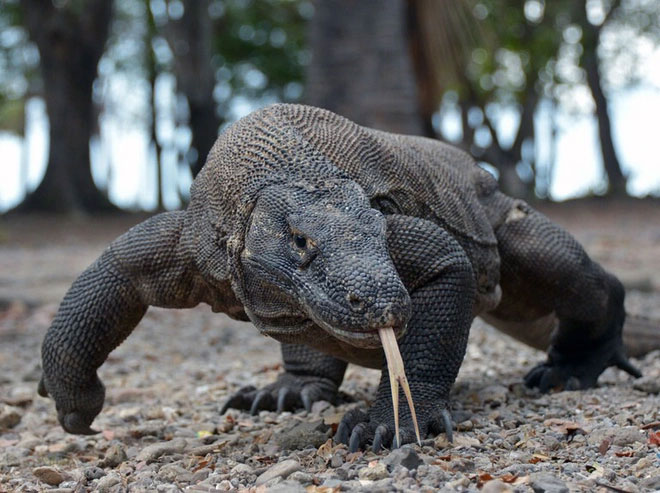
How Komodo dragons feed
Komodo dragons are opportunistic carnivores. They eat carrion as well as live prey and can consume skin, connective tissue, and smaller bones. Their curved, serrated teeth are effective at gripping and tearing, while powerful neck muscles help them pull food apart.
Hard material is not “dissolved like a snake” in a special way; strong stomach acid and normal reptile digestion break down much of a meal, and indigestible material may be expelled. The exact amount an individual can eat depends on its size, condition, and access to food, so dramatic maximum figures should not be treated as typical meals.
Where Komodo dragons live
The Komodo dragon (Varanus komodoensis) is the largest living species of lizard. Wild populations occur on a small number of Indonesian islands, including Komodo, Rinca, Flores, and nearby islands. Their restricted range is one reason habitat protection and careful management are important.
Why the turtle shell does not provide complete protection
A turtle shell is strong, but it is not indestructible. Openings around the head and limbs can give a predator purchase, existing damage or decomposition may weaken the shell, and a large Komodo dragon can apply repeated force from different angles. A single video cannot establish the condition of the carcass before filming, so it is safer to describe the visible behavior than to assign a precise bite-force explanation.
Safety and viewing note
Komodo dragons are wild predators and should be observed only at a safe distance under the direction of trained local guides. Their feeding behavior can be sudden, and approaching an animal or carcass can be dangerous. The embedded video contains scenes of an animal feeding on another animal and may not be suitable for all viewers.
Related Articles
 Horrifying Scene of Komodo Dragon Swallowing a Baby Goat in a Split3 minutes read
 Komodo Assassin Dragon Slayed a Giant Buffalo with a Cup4 minutes read
 Komodo Dragon Blood Helps Fight Antibiotic Resistant Bacteria5 minutes read
 What Is a Mangrove?: What Is a Mangrove Turtle4 minutes read
 10 Interesting Facts About Indonesia Country4 minutes read
 Swallowing Nearly 1,000 Coins, Thai Turtles Died of Blood Infections2 minutes read
Reader Comments 0
Sign in with email or Google to join the discussion.