Table of Contents
Could rapidly advancing artificial intelligence make an extraterrestrial civilization harder for us to detect? A theoretical SETI paper explores that possibility: a civilization might spend only a short period using technology whose signals overlap with our search methods. This is a hypothesis about detectability, not evidence that alien AI exists.

What is the detection-window idea?
In “Blink and you'll miss it”, Michael Garrett models how technological acceleration could shorten the phase during which a civilization is recognizable to current searches. The faster technology changes, the shorter that overlap can become under the model's assumptions.
The argument extends a question Carl Sagan discussed in 1973: how well could we recognize a civilization far ahead of our own? Sagan's communication-horizon paper used a hypothetical horizon, not a measured universal timetable for alien development.
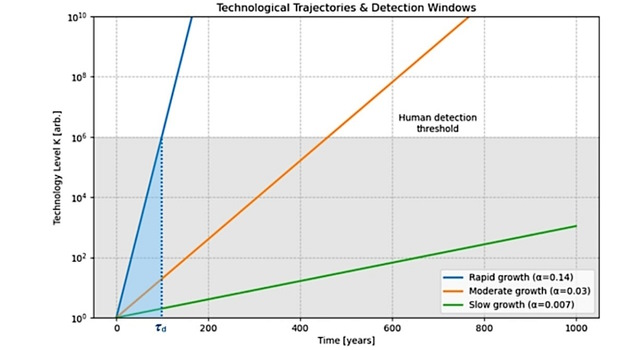
Where AI enters the argument
The proposed scenario allows for civilizations whose dominant intelligence is no longer biological. If AI accelerates technical change, a period of familiar radio or optical signaling could be brief compared with a civilization's overall lifetime.
That does not mean the civilization literally turns invisible. It means some signatures may become difficult to recognize with a particular instrument or search strategy. It also does not establish that human superintelligence will arrive on a specific date or follow an inevitable path.

What the model does not prove
- That extraterrestrial civilizations exist or are common.
- That their technology develops like ours or continues accelerating indefinitely.
- That they stop producing every observable signature.
- That the probability of finding them is zero.
A short modeled window depends on choices about development rates and detection limits. Those quantities are uncertain. The idea is one possible contribution to discussions of the Fermi paradox and the lack of confirmed contact, rather than a solution established by observation.
Why this could change how we search
Garrett argues for broadening searches beyond familiar communication signals to more persistent traces, including unusual energy emissions and patterns across multiple kinds of astronomical data. The paper also proposes using AI to help identify anomalies.
An anomaly would still need follow-up and ordinary explanations checked before being attributed to technology. AI can help search data; it cannot turn an unexplained signal into proof of an alien civilization.
The practical takeaway is to question overly narrow assumptions about what intelligence should look like. For the distinction between present AI systems and hypothetical advanced agents, see common AI terminology.
Related Articles
 How to download and install Galactic Civilizations III for free
 Invitation to turn-based strategy game Galactic Civilizations II: Ultimate Edition, is free
 Discovering 'alien antenna' on the Moon?
 Doctor of Philosophy of Science: We may have discovered traces of aliens already, we just don't know what it is.
 How to send invisible messages on iPhone
 How Alien Life Exists Without Water
Reader Comments 0
Sign in with email or Google to join the discussion.