What you will learn
- Define workflow inputs, stages and outputs.
- Version prompts and examples.
- Add review gates and failure routes.
- Measure quality across representative cases.
What you need
- A recurring task already completed manually at least once.
- Examples of acceptable and unacceptable outputs.
Design the process around interfaces and ownership
NIST’s AI RMF Core describes governance, mapping, measurement and management as continuous functions and notes that documentation can improve transparency, human review and accountability.
OpenAI’s prompt guidance emphasizes clear instructions and iterative refinement, which become more reliable when prompt versions and test cases are recorded.
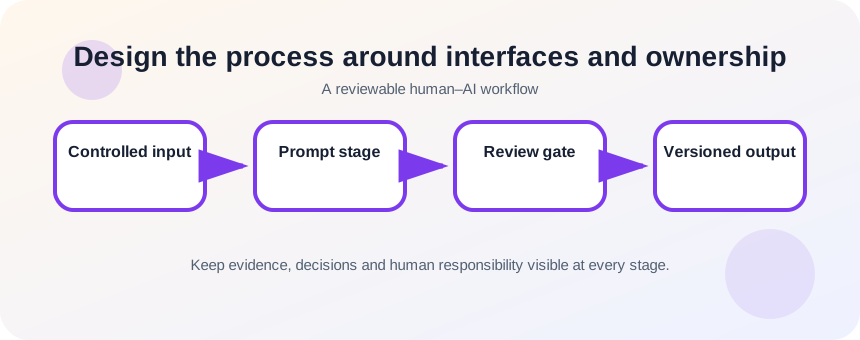
A workflow stage should have one purpose and a defined handoff. Inputs might be approved notes and a template. An intermediate output might be extracted claims. A review gate checks evidence. The final output is published only after a named owner approves it.
Map the current manual process
Document what already happens, including exceptions and judgment. Automation fails when it models the ideal procedure but ignores how missing files, urgent requests or disputed facts are handled. Identify which steps are deterministic and which require expertise.
- 1
Name the trigger.
- 2
List required inputs and their owners.
- 3
Map the current steps.
- 4
Mark decisions and exceptions.
- 5
Define the final output and destination.
- 6
Identify where AI can assist without owning the outcome.
Build stages with reviewable contracts
Use separate stages for extraction, generation, verification and formatting when possible. Store prompt versions and examples. At each handoff, define what must be present, what causes rejection and where failed cases go. Add logs that contain identifiers and outcomes without unnecessarily copying sensitive content.
- 1
Create a controlled input folder or form.
- 2
Assign a versioned prompt to one stage.
- 3
Save the intermediate output.
- 4
Run automated checks where rules are deterministic.
- 5
Route ambiguous cases to a human.
- 6
Record reviewer decision and reason.
- 7
Publish only the approved output.
- 8
Monitor errors and update the prompt version.
Measure the workflow, not only the model
Track time saved, correction rate, rejected cases, high-impact errors and user outcomes. A faster workflow that creates more rework is not productive. Re-test after model, prompt, source or policy changes. Retire stages that no longer have a clear owner.
Design each handoff with an explicit input contract and output contract. The input contract names required fields, approved sources and prohibited data; the output contract defines format, confidence labels and validation rules. When a stage fails, route the item to review rather than passing malformed content downstream. These contracts make a workflow testable and prevent one ambiguous AI response from contaminating every later step.
- Every stage has an input, output and owner.
- Failed or ambiguous cases have a route.
- Prompt and evaluation versions are recorded.
Document one recurring AI workflow
Turn a repeated drafting or extraction task into a reviewable process.
- 1
Map the manual process.
- 2
Choose one AI-assisted stage.
- 3
Define its prompt and inputs.
- 4
Create acceptance and rejection criteria.
- 5
Run five representative cases.
- 6
Record errors and publish the workflow version.
Common mistakes to avoid
- Automating before understanding exceptions.
- Using one prompt for extraction, judgment and publishing.
- Failing to version prompts.
- Measuring only speed.
Key takeaways
- Repeatability comes from defined interfaces and versions.
- Review gates and failure routes are first-class workflow stages.
- Measure outcomes, not novelty.
Frequently asked questions
Do I need software automation to have an AI workflow?
No. A documented manual sequence with reusable prompts and review gates is already a workflow and is often the safest pilot.
When should I update a prompt version?
Update when requirements, examples, model behavior or source material change, and re-run the evaluation set before release.
Sources and further reading
- AI RMF CoreNIST AI Resource Center
- Prompt engineering best practices for ChatGPTOpenAI Help Center
Ready to continue?
Mark the lesson complete so your Learning Path progress stays current on this device.