What you will learn
- Define the accountable reviewer and decision.
- Provide evidence and uncertainty at approval time.
- Create rejection and escalation criteria.
- Record decisions and monitor outcomes.
What you need
- An AI-assisted deliverable or workflow.
- A person or role with authority over the final outcome.
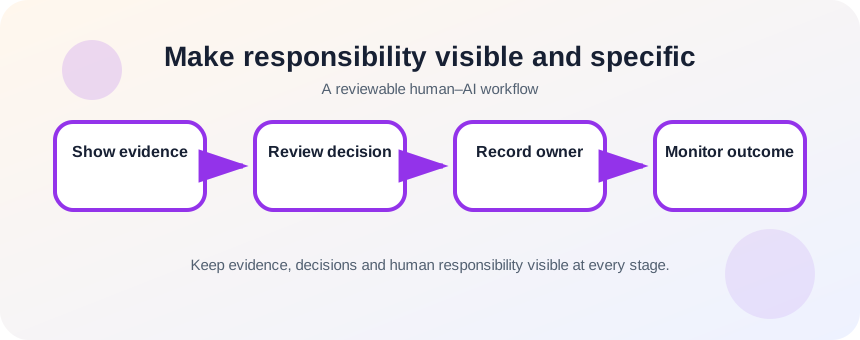
Make responsibility visible and specific
The NIST AI RMF Core states that governance is continuous, documentation supports transparency and human review, and roles and responsibilities for human-AI configurations should be defined.
Microsoft’s responsible AI principles include transparency and accountability alongside fairness, reliability, safety, privacy and inclusiveness.
UNESCO’s recommendation emphasizes human oversight and determination as part of a human-rights-centered approach to AI.
Sign-off should identify the decision being approved, not simply “AI output reviewed.” The approver for factual publication may be an editor; the approver for financial action may be an authorized manager; the approver for safety advice may require specialist credentials.
Define reviewer competence and evidence
The reviewer needs enough domain knowledge, time and source access to detect material errors. Provide the original request, inputs, evidence, prompt or workflow version, known limitations and previous review results. Avoid overwhelming the reviewer with raw logs that hide the important decision.
- 1
Name the final decision.
- 2
Assign the accountable role.
- 3
Define required competence.
- 4
List evidence shown at review.
- 5
Write rejection and escalation criteria.
- 6
Set a reasonable review time.
Run a documented sign-off
Present the proposed output with highlighted high-impact claims, uncertainty and changes made after AI generation. Require the reviewer to choose approve, revise, reject or escalate and record a short reason. Keep the decision record with the released version.
- 1
Open the final candidate and evidence package.
- 2
Check mandatory requirements.
- 3
Verify high-impact claims.
- 4
Review privacy, fairness and audience impact.
- 5
Choose the disposition.
- 6
Record reviewer, date and reason.
- 7
Publish or act only after approval.
- 8
Monitor complaints, corrections and outcomes.
Improve the sign-off process with outcome data
Track corrections, overrides, incidents and reviewer workload. If almost every output is approved, determine whether the workflow is genuinely reliable or the review has become ceremonial. Reassign or stop the workflow when reviewers lack authority or expertise.
Calibrate review effort to consequence and novelty. A familiar low-risk draft may use a short checklist, while a new workflow affecting money, eligibility, safety or public reputation needs independent evidence and specialist approval. Sample previously approved outputs and measure corrections, overrides and incidents. If reviewers approve nearly everything in seconds, redesign the evidence package or reduce automation rather than treating the checkbox as meaningful oversight.
- A named person owns the final decision.
- The approver can inspect evidence and reject.
- The released version and sign-off record are linked.
Create a one-page AI sign-off form
Design an approval form for a recurring AI-assisted deliverable.
- 1
State the decision and owner.
- 2
List required evidence.
- 3
Add high-impact claim checks.
- 4
Add privacy and fairness checks.
- 5
Create approve, revise, reject and escalate options.
- 6
Test the form on a sample output.
Common mistakes to avoid
- Using an anonymous approval queue.
- Showing only the AI recommendation, not the evidence.
- Making rejection difficult or penalized.
- Failing to monitor outcomes after approval.
Key takeaways
- Human sign-off requires competence, evidence and authority.
- Decision records support accountability and learning.
- Oversight continues after release through outcome monitoring.
Frequently asked questions
Does every AI output need formal sign-off?
No. The process should be proportionate to consequence. High-impact, external or irreversible uses need stronger approval than low-risk internal brainstorming.
Can the reviewer use AI to help review?
AI can organize checks, but the accountable human must still inspect evidence and own the decision.
Sources and further reading
- AI RMF CoreNIST AI Resource Center
- Responsible AI principles and approachMicrosoft
- Recommendation on the Ethics of Artificial IntelligenceUNESCO
Ready to continue?
Mark the lesson complete so your Learning Path progress stays current on this device.