What you will learn
- Track source material used in an AI-assisted work.
- Verify quotations and references.
- Distinguish AI assistance from human authorship.
- Apply attribution and disclosure rules for the context.
What you need
- The source materials and licenses used for a project.
- The publication, client or organizational attribution policy.
Separate copyright, attribution and factual citation
The U.S. Copyright Office maintains an ongoing AI initiative addressing digital replicas, copyrightability of generated outputs and training-related questions.
In its 2025 Part 2 report, the Office stated that AI-assisted work can be protected where sufficient human-authored expressive elements are present, while prompts alone do not automatically establish copyrightable authorship.
A factual citation shows where a claim came from. Attribution credits a creator or source as required by ethics, license or policy. Copyright determines legal rights in protected expression. These concepts overlap but are not interchangeable.
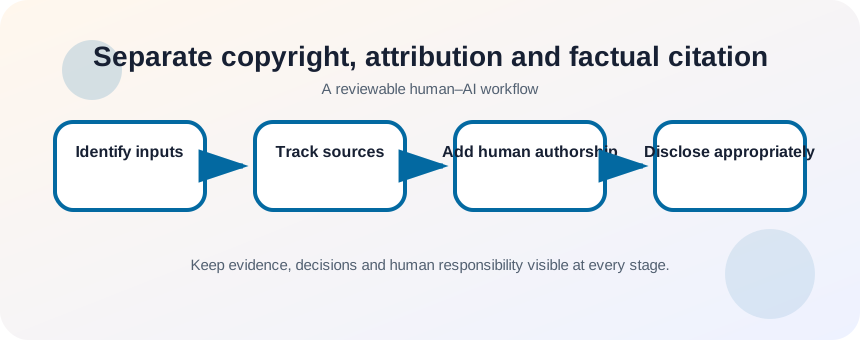
Create a provenance record before drafting
List the human-created materials, licensed assets, quotations, datasets and AI tools used. Record URLs, authors, licenses and access dates. Do not ask the model to reconstruct citations after the fact; generated references may be incorrect.
- 1
Inventory source documents and media.
- 2
Record creator, title, URL and license.
- 3
Mark direct quotations.
- 4
Separate your notes from copied text.
- 5
Record the AI tool and purpose.
- 6
Identify the human creative decisions.
Draft with source boundaries and human contribution
Use AI to organize or transform material you are authorized to use. Verify every quotation and reference in the original. Make substantive human choices about selection, arrangement, wording, examples and final meaning. Follow client and platform disclosure rules, especially for academic, journalistic or commissioned work.
- 1
Provide only authorized source material.
- 2
Require citations to be verified externally.
- 3
Review for close copying or imitation.
- 4
Rewrite with your own analysis and decisions.
- 5
Add required credits and license notices.
- 6
Document human edits and creative arrangement.
- 7
Complete the final policy or legal review.
Check the final work and publication context
Confirm that quotations are accurate, licenses permit the use, attribution is complete and the work does not imply original research that was never performed. Copyright rules differ by jurisdiction and continue to develop, so obtain legal advice for disputes, commercial licensing or uncertain ownership.
Keep three records separate: factual sources that support claims, licensed material reused in the output, and the human creative decisions that shaped the final work. A citation may satisfy research transparency but does not automatically grant permission to reproduce protected expression. For publication or commercial use, inspect the original license and platform terms, retain drafts showing human contribution and escalate uncertain ownership questions.
- Every quotation and reference is verified.
- Required creator and license information is present.
- The human contribution and AI assistance are documented appropriately.
Create a source and authorship log
Audit one AI-assisted article or design.
- 1
List every external input.
- 2
Verify citations and quotations.
- 3
Record licenses.
- 4
Describe the AI contribution.
- 5
Describe the human creative decisions.
- 6
Add required attribution or disclosure.
Common mistakes to avoid
- Assuming generated text is automatically original.
- Using a model-generated bibliography without opening sources.
- Confusing factual citation with copyright permission.
- Hiding AI assistance when policy requires disclosure.
Key takeaways
- Source provenance should be recorded from the start.
- AI assistance does not eliminate human authorship or licensing questions.
- Verify references and follow context-specific rules.
Frequently asked questions
Who owns AI-generated content?
The answer depends on jurisdiction, human authorship, contracts and platform terms. Obtain legal advice for important commercial decisions.
Do I need to cite AI itself?
Follow the rules of the publication, school, client or platform. More importantly, cite and verify the underlying factual sources.
Sources and further reading
- Copyright and Artificial IntelligenceU.S. Copyright Office
- Copyright Office Releases Part 2 of Artificial Intelligence ReportU.S. Copyright Office
Ready to continue?
Mark the lesson complete so your Learning Path progress stays current on this device.