What you will learn
- Create an audience profile tied to the communication goal.
- Adjust assumptions, vocabulary, examples and depth.
- Preserve facts while changing presentation.
- Test comprehension and action clarity.
What you need
- A fact-checked draft.
- A specific reader or audience segment.
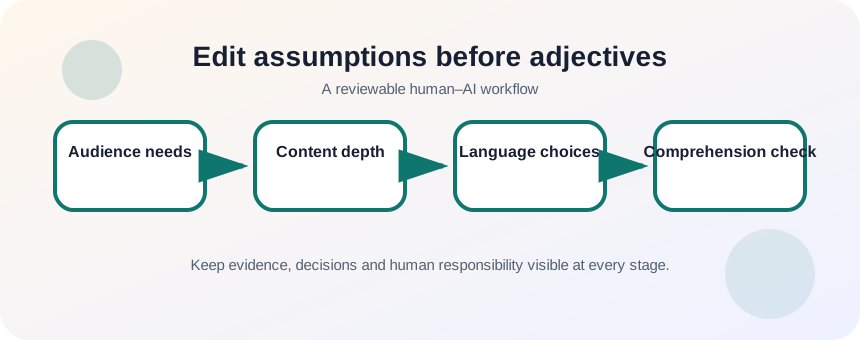
Edit assumptions before adjectives
OpenAI’s prompt guidance recommends specifying context and can use descriptive tone guidance when it supports the desired result.
Microsoft’s responsible AI principles include inclusiveness and transparency, which support making information understandable and usable for the people affected.
Tone matters, but hidden assumptions matter more. A draft may assume technical vocabulary, legal knowledge, access to a desktop computer or authority to approve a purchase. Audience editing reveals and corrects those assumptions.
Write a one-paragraph reader profile
Describe the reader’s goal, prior knowledge, likely question, constraints and desired action. Avoid stereotypes based on age, job title or nationality. Use evidence from actual support questions, interviews or product context when available.
- 1
Name the reader’s immediate goal.
- 2
List terms they may not know.
- 3
Identify what evidence they need to trust the message.
- 4
Choose one desired action.
- 5
Record accessibility or device constraints.
- 6
Define what must remain unchanged.
Create an audience-specific revision brief
Tell the AI what to preserve and what to change. For example: keep every date and commitment, explain two technical terms, move the action to the first paragraph and remove internal jargon. Ask for a change log so the editor can confirm that factual meaning did not drift.
- 1
Provide the verified draft.
- 2
Provide the reader profile.
- 3
List facts that must remain exact.
- 4
Specify assumptions to explain or remove.
- 5
Set reading depth and structure.
- 6
Request the revised draft plus a change log.
- 7
Compare key claims with the original.
Test comprehension, not only tone
Ask a representative reader what the message means and what they would do next. Look for unexplained terms, buried actions and misleading simplifications. Automated readability scores can flag complexity but cannot prove comprehension or suitability.
Audience editing should change more than vocabulary. A new employee may need definitions and a safe first action; an executive may need the decision, evidence and risk; a customer may need the consequence and next step. Test the revision with a short comprehension question: what should this reader know, feel confident about and do next? If those answers are unclear, the edit is not finished.
- The reader can identify the main point quickly.
- Technical terms are defined or removed.
- Facts and commitments match the verified draft.
Create two audience versions
Edit one factual notice for a beginner and a decision-maker.
- 1
Write profiles for both readers.
- 2
Mark facts that cannot change.
- 3
Create two revision briefs.
- 4
Generate both versions.
- 5
Compare claim fidelity.
- 6
Test whether each reader can identify the required action.
Common mistakes to avoid
- Using tone as a substitute for audience analysis.
- Removing necessary limitations to make the message simpler.
- Adding stereotypes to personalize the copy.
- Changing commitments during rewriting.
Key takeaways
- Audience editing changes assumptions, depth and action.
- Facts must remain stable across versions.
- Comprehension requires testing with real readers.
Frequently asked questions
Can AI determine my audience automatically?
It can suggest likely reader needs, but the communicator should define and validate the audience using real context and evidence.
Is a lower reading level always better?
No. Use the simplest language that preserves necessary precision for the reader and task.
Sources and further reading
- Prompt engineering best practices for ChatGPTOpenAI Help Center
- Responsible AI principles and approachMicrosoft
Ready to continue?
Mark the lesson complete so your Learning Path progress stays current on this device.