Table of Contents
This updated guide examines Formula to Calculate Trapezoidal Area: Normal, Square, Weight and organizes the essential facts, background, and practical takeaways in clear American English.
Trapezoid is a convex quadrilateral with two parallel sides that we meet quite a lot in daily life. The two parallel sides of the trapezoid are called the bottom edges, the other edges are called the sides. If the calculation of the trapezoidal circumference is quite easy to remember, simply adding a total of 4 edges, the formula for calculating the area of the trapezoid is more difficult to remember.
There are 3 common trapezoidal types:
- Trapezoid usually
- Square trapezoid
- Scale trapezoid
Find out more in the following content.
Formula to calculate trapezoidal area
There are trapezoid ABCD with the bottom length AB is a, bottom CD is b and height h.

The general formula calculates the area of a trapezoid: the average plus two bottom edges multiplied by the height between the two bottoms.

Inside:
- S is a trapezoidal area.
- a and b are the length of the bottom 2 sides.
- h is the lower height from the bottom edge a to b or vice versa (the distance between the two bottom edges).
Square trapezoid area
The square trapezoid is a trapezoid with a right angle. The perpendicular to the two bottoms is also the height h of the trapezoid.
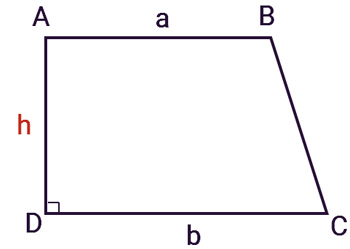
The general formula calculates the area of a square trapezoid similar to a normal trapezoid: the average of two bottom edges multiplied by the height between the two troughs , however, the height here is the perpendicular side to both troughs.

Inside:
- S is a trapezoidal area.
- a and b are the length of the bottom 2 sides.
- h is the side length perpendicular to the 2 bottoms.
Scale trapezoid
The trapezoidal scale is a trapezoid with two adjacent angles at an equal bottom. The two sides of the trapezoid are balanced and not parallel to each other.
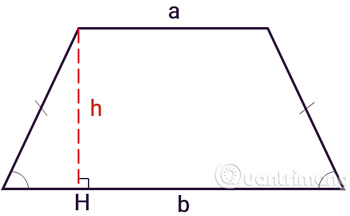
In addition to applying the formula as a normal trapezoid, you can also divide the scale into a scale to calculate the area of each section and then add it together.
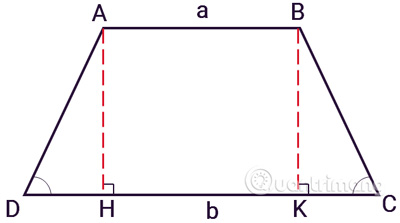
Suppose, the scale trapezoid ABCD has two sides AD and BC equal. The height of AH and BK, trapezoidal will be divided into 1 ABKH rectangle and 2 triangles ADH and BCK. Apply the formula to calculate rectangular area for ABHK and triangle area for ADH and BCK then add all areas to find the area of trapezoid ABCD.
Specifically this:

Which SADH= SBCK(easy to stop), we get:


Above is the article of TipsMake.com about Formula, how to calculate the most standard trapezoidal area. Hope the article will be useful to you!
FAQ
What is Formula to Calculate Trapezoidal Area: Normal, Square, Weight about?
It provides a structured overview of area of trapezoidal formulas, explains the main context, and highlights practical takeaways for readers.
Why does this topic matter?
Understanding the main concepts helps readers evaluate the issue, avoid common mistakes, and make better-informed decisions.
How should readers use this information?
Use the guidance as a practical starting point, confirm details that may have changed, and follow current product, safety, or security recommendations.
Related Articles
 Area of a Square, Perimeter of a Square: Formulas and Illustrative Examples9 minutes read
 Formula to Calculate Square Area, Perimeter of Square3 minutes read
 Formula to Calculate the Area of a Triangle: Square, Regular6 minutes read
 The Formula for Calculating Rectangular Box Area, Rectangular Box4 minutes read
 The Square Root Formula in Excel - the Square Root Function in Excel4 minutes read
 Formula to Calculate the Area Around the Cone, the Total Area of3 minutes read
Reader Comments 0
Sign in with email or Google to join the discussion.