Table of Contents
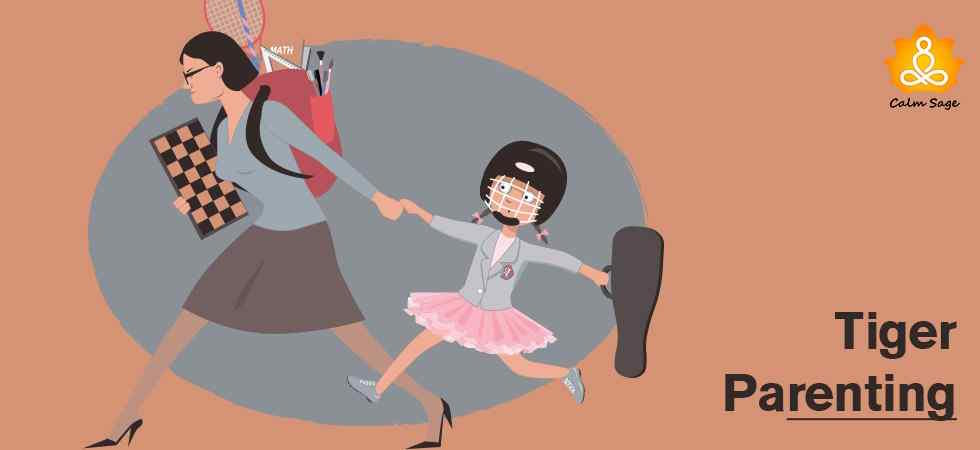
Tiger parenting describes a high-control, achievement-focused approach in which parents set demanding standards and give children limited influence over decisions. It is often associated with intensive academic pressure, strict discipline, correction, and sacrifice for future success.
The term is not a clinical diagnosis, and it should not be used as a stereotype for Asian or Asian American families. Parenting practices vary widely within every culture. Research on Chinese American families found several parenting profiles and did not identify tiger parenting as the most common or the one associated with the strongest overall outcomes.

What tiger parenting looks like
High expectations alone do not make someone a tiger parent. A parent can expect effort, set firm limits, and require family responsibilities while also listening, explaining rules, and responding warmly. The concern is the combination of intense performance pressure, psychological control, punitive responses, and limited room for the child's perspective.
Common patterns may include:
- Treating top grades, awards, or admission to a prestigious program as the main evidence of success.
- Choosing activities or career goals with little input from the child.
- Using shame, comparison, withdrawal of affection, or threats of disappointment to motivate performance.
- Focusing on errors and improvement while rarely recognizing progress.
- Interpreting disagreement as disobedience rather than information.
- Restricting rest, play, friendships, or interests whenever they compete with achievement.
- Believing that pressure is always necessary and that praise inevitably makes a child weak.
- Responding to fear of failure by increasing control.
A rule about smartphones, homework, bedtime, or safety is not automatically tiger parenting. The important questions are whether the limit is age-appropriate, explained, consistent, open to discussion, and enforced without humiliation or fear.
Why parents adopt a high-control approach
Strict achievement pressure often comes from care rather than indifference. Parents may have lived through poverty, instability, discrimination, scarce educational opportunities, or intense competition. They may view discipline and academic success as protection against a difficult future. Family obligation, respect for expertise, perseverance, and delayed gratification can also be deeply valued.
Those values do not require harsh methods. A parent's intention and a child's experience can differ: a parent may mean “I am preparing you,” while the child hears “I am acceptable only when I succeed.” Recognizing that gap is not an attack on family culture; it is an opportunity to choose methods that preserve both connection and standards.

What the research does—and does not—show
A longitudinal study of Chinese American families identified supportive, tiger, easygoing, and harsh parenting profiles. Supportive parenting was more common than tiger parenting and was associated with better overall adolescent outcomes in that study. Compared with the supportive profile, the tiger profile was linked with more academic pressure and less favorable emotional and educational outcomes.
The study is valuable because it challenges the idea that strict “tiger” methods are typical or uniquely successful. It does not prove that every family will have the same outcome, and its findings should not be generalized to every Asian group, country, child, or cultural setting. The authors discuss those limits in the full research paper.
More broadly, positive parenting guidance emphasizes warmth, clear limits, open communication, modeling, and age-appropriate responsibility. Achievement is only one part of development. Health, relationships, emotional skills, curiosity, integrity, and the ability to recover from mistakes also matter.
Possible strengths and possible costs
| Practice or value | Potential benefit | When it becomes harmful |
|---|---|---|
| High expectations | Can communicate confidence and encourage effort | When love, safety, or belonging seems conditional on performance |
| Structure and routines | Can build predictability and work habits | When rules are rigid, unexplained, or unrelated to the child's age and needs |
| Persistence | Can help a child tolerate frustration and practice a skill | When stopping, resting, changing direction, or asking for help is treated as weakness |
| Family responsibility | Can support cooperation and connection | When guilt or shame is used to erase healthy boundaries |
| Critical feedback | Can identify a specific skill to improve | When criticism is constant, personal, public, or disconnected from support |
| Parental sacrifice | Can provide opportunity and stability | When the sacrifice becomes a debt the child must repay through obedience or achievement |
A child may perform well while also feeling anxious, isolated, or unable to make independent decisions. Report cards alone cannot show whether the approach is healthy.
Self-check: are high standards becoming excessive control?
Consider the pattern over time rather than one difficult evening:
- Can your child disagree respectfully without fearing rejection or humiliation?
- Do you ask about their goals, or mainly tell them what their goals should be?
- Is there room for sleep, play, friendship, and interests that do not produce an award?
- When they make a mistake, do you teach the next step or attack their character?
- Do you praise effort, strategy, honesty, and improvement as well as the final result?
- Can a plan change when the child's health, abilities, or interests change?
- Would your child tell you about a failure before you discovered it elsewhere?
- Are limits based on safety and values, or on comparison with other families?
If several answers are uncomfortable, choose one behavior to change. A relationship rarely improves through a new lecture about closeness.
Keep high expectations, change the method
Set expectations collaboratively
Explain the reason for a requirement and invite the child's perspective. For a school goal, discuss the current level, available time, health, support needed, and what progress would look like. Parents retain responsibility for age-appropriate limits, but collaboration teaches planning rather than mere compliance.
Separate worth from performance
Say explicitly that a grade or result is information, not a measure of the child's value. After a setback, begin with connection: “I know you worked hard and this is disappointing.” Then examine what can change—study method, workload, tutoring, sleep, expectations, or the goal itself.
Use specific feedback
Replace “You're lazy” with an observable concern: “The assignment was started after midnight twice this week. What is getting in the way?” Specific language makes problem-solving possible and avoids turning a behavior into an identity.
Recognize process and recovery
Notice preparation, persistence, honesty, asking for help, correcting an error, and trying a new strategy. Praise should be sincere and precise, not constant or exaggerated. A child needs to learn that effort matters and that ineffective effort can be adjusted.
Protect rest and emotional safety
Sleep, breaks, relationships, and play are not rewards that a child must earn through perfect performance. They are part of healthy development. If pressure is causing persistent sleep problems, withdrawal, hopelessness, panic, self-harm talk, or major changes in eating, mood, or functioning, seek prompt help from a pediatrician or qualified mental health professional. In an immediate safety crisis, contact local emergency services or a crisis service in your country.
A more supportive conversation
Try this sequence after a disappointing result:
- Listen: “Tell me what happened from your point of view.”
- Reflect: “You sound frustrated and worried about what comes next.”
- Clarify the goal: “What outcome matters to you now?”
- Offer support: “Would you like help making a plan, finding a resource, or just some time?”
- Agree on a next step: choose one realistic action and a time to check in.
Our guide to nonviolent communication provides a useful structure for observations, feelings, needs, and requests. For younger children, these mental health activities can help families practice naming emotions and talking openly.
Firm parenting and supportive parenting are not opposites. The practical alternative to tiger parenting is not abandoning standards; it is combining clear expectations with warmth, explanation, flexibility, and increasing autonomy as the child develops.
Related Articles
 Teach Parents How to Raise Healthy, Smart, Scientific Children11 minutes read
 The Danger When Saying 'be Careful' to Young Children That Parents9 minutes read
 Parents of Smart, Successful Children Often Do 10 Things7 minutes read
 The Secret of Sex Education for Parents Needs to Know10 minutes read
![[funny] a Bunch of Funny Photos About the Difference Between](/data/thumbs_200x120/[funny]-a-bunch-of-funny-photos-about-the-difference-between-raising-first-and-second-children_thumbs_200x120_3QmWOsC9l.jpg) [funny] a Bunch of Funny Photos About the Difference Between4 minutes read
[funny] a Bunch of Funny Photos About the Difference Between4 minutes read 12 Simple Tips to Be a Good Father: Spending Time with Children7 minutes read
Reader Comments 0
Sign in with email or Google to join the discussion.