Table of Contents
Amazing Super Planet with Iron Winds, Ruby Rain is easier to approach with a clear overview and reliable steps. This guide organizes the essential information, highlights practical details, and explains what to check along the way.
Key Takeaways
- Follow the recommended steps in order to avoid common mistakes with amazing super planet with iron winds, ruby rain.
- Review compatibility, settings, or requirements before making changes.
- Use the troubleshooting notes to confirm the final result.
 TipsMake.com
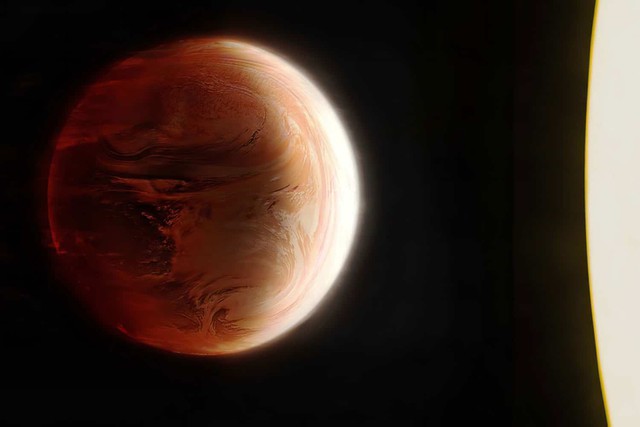
Portrait of the raging super planet Tylos - Image: Engine House VFX.
Tylos, also known as WASP-121b, is a hot Jupiter located 880 light-years from Earth.
Hot Jupiters are gas planets similar in type to Jupiter in the Solar System but are extremely hot.
Tylos has a radius about 1.74 times that of Jupiter and a mass 1.16 times that of Jupiter, orbiting so closely that a year there is only 30 days long on Earth, resulting in surface temperatures reaching more than 2,000 degrees Celsius.
This planet is also divided into two sides, a permanent day and a permanent night, due to being tidally locked to its parent star, just like the Moon is tidally locked to Earth.
Tylos' atmosphere is leaking into space, causing it to literally evaporate.
Even more strangely, it was an atmosphere filled with metals and precious stones. Data showed that this world was surrounded by a layer of iron and titanium mist, which continuously rained liquid rubies and sapphires down to the ground.
Adding to the horror, new research shows that the world's iron winds are incredibly violent. One jet stream rotates matter around the planet's equator, while another in the lower layers of the atmosphere moves gas from the hotter side to the cooler side.

Hot and furious weather in Tylos - Graphic image: NASA.
"This type of climate has never been seen on any planet before. Even the most powerful storms in the solar system seem calm by comparison," said Dr. Seidel.
The speed of the iron winds here is up to 13.7-28.6 km/s (about 49,000-103,000 km/h). For comparison, the maximum wind speed of a Category 17 hurricane on Earth is 220 km/h.
The day-night temperature difference between the two sides due to the planet's tidal locking is thought to contribute to such terrifying jet streams.
That's the highest wind speed scientists have ever estimated for a planet. It's also the first time titanium has been detected in the atmosphere of a distant world. On Tylos, titanium clouds are buried in the lower levels.
Final Thoughts
The most reliable way to handle amazing super planet with iron winds, ruby rain is to follow the process in order, verify each important setting, and test the result before moving on. Use the guidance above as a practical reference, then adjust the details for your device, software version, or specific goal.
FAQ
What should I know first about Amazing Super Planet with Iron Winds, Ruby Rain?
According to Science Alert, a research team led by astrophysicist Julia Victoria Seidel of the European Southern Observatory (ESO) has successfully recreated the atmosphere of the giant planet Tylos through a 3D virtual model.
How do I get the best results with Amazing Super Planet with Iron Winds, Ruby Rain?
Use current software or equipment, follow the steps in order, review the recommended settings, and test one change at a time so you can identify what improves the result.
What should I do if Amazing Super Planet with Iron Winds, Ruby Rain doesn't work as expected?
Check compatibility, permissions, connectivity, and version-specific settings. Restart the relevant device or app, then repeat the process carefully before trying a more advanced fix.
Related Articles
 Iron Rain on the Planet 'Hell' 640 Earth Light Years3 minutes read
 Strange Weather Phenomena Can Only Be Seen in the Universe6 minutes read
 New Discovery: Iron Snow Rains Are Happening Inside the Earth's3 minutes read
 Ruby Programming Language for Beginners3 minutes read
 Summarize the Best Moods About Rain: Mood When Rain10 minutes read
 How to Execute Ruby Code7 minutes read
Reader Comments 0
Sign in with email or Google to join the discussion.