Table of Contents
The first image of the black hole was announced by international scientists in the Event Horizon Telescope (EHT) program at the press conference held at 20:00 last night, April 10, 2019 (by hour Vietnam). This image captures the light formed by dust and gas surrounding the supermassive black hole at the center of the galaxy Messier 87 (M87) located 55 million light-years from Earth.
Key Facts About Black Hole
Scientists at EHT call M87 a "monster" black hole because it is large in size with a diameter of 40 billion km, three million times larger than Earth.

A black hole (black hole or black hole) is a spaceless space in the universe whose gravity is so great that no matter can escape, including light.
 Source: Guardian.
But thanks to an Earth-sized virtual telescope made up of a network of eight radio telescopes located in many locations around the world, from Antarctica to Spain and Chile, astronomers For the first time, it recorded the black hole event horizon.
FAQ
What is black hole?
The first image of the black hole was announced by international scientists in the Event Horizon Telescope (EHT) program at the press conference held at 20:00 last night, April 10, 2019 (by hour Vietnam).
What makes black hole notable?
This image captures the light formed by dust and gas surrounding the supermassive black hole at the center of the galaxy Messier 87 (M87) located 55 million light-years from Earth.
What are the key facts about black hole?
A black hole (black hole or black hole) is a spaceless space in the universe whose gravity is so great that no matter can escape, including light.
Related Articles
 Scientists Witness the 'Resurrection' of a Monstrous Black Hole After 100 Million Years5 minutes read
 Scientists Witness the 'Resurrection' of a Monstrous Black Hole After 100 Million Years4 minutes read
 Shocking Discovery in Astronomy: 3 Supermassive Black Holes in4 minutes read
 Discover the Most Bizarre Black Holes in the Mysterious Space6 minutes read
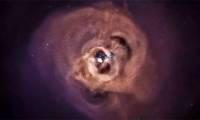 Listen to the Scary Sound of a Black Hole 250 Million Light Years3 minutes read
 Science Has Discovered the Fastest-flying Star in the Milky Way, Reaching8 minutes read
Reader Comments 0
Sign in with email or Google to join the discussion.