What you will learn
- Describe a generative model as a system that predicts output from patterns and context.
- Separate fluency from factual accuracy.
- Identify which parts of a task require external tools or evidence.
- Place human review at the correct point in a work session.
What you need
- Access to a general-purpose AI assistant.
- A short real question or document you can use as a test input.
Replace the “digital expert” metaphor with a prediction workflow
OpenAI explains that ChatGPT produces useful responses from patterns in training data but can still give incorrect definitions, dates, facts, quotations and references. Confident language is therefore not a reliability score.
NIST’s Generative AI Profile treats generative systems as technologies with distinctive risks that should be identified, measured and managed across the way they are used—not only at model creation time.
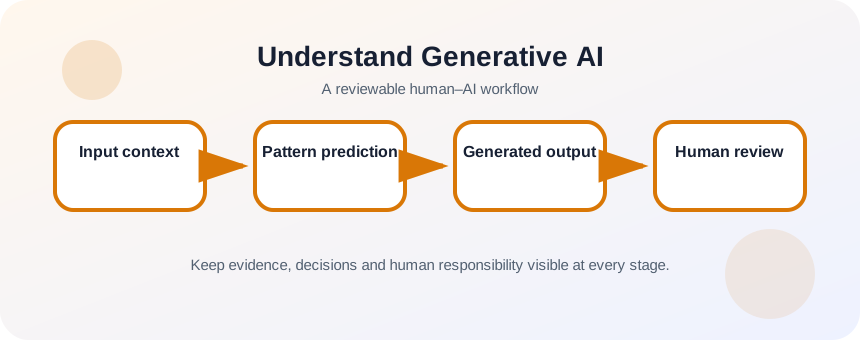
A useful mental model has four parts: the input you provide, the patterns the model can use, the generated output, and the review or tool call that determines whether the result is safe to use. Context changes the probability of the next response; it does not turn the model into the original source of a law, statistic or event.
Observe how context changes the answer
Use one neutral topic and ask three versions of the same request. The goal is not to discover a magic prompt. It is to see that the model’s response depends heavily on the task framing, source material and constraints you supply.
- 1
Choose a topic you already understand well enough to judge.
- 2
Ask a broad question with no context and save the answer.
- 3
Ask again with a defined audience and purpose.
- 4
Ask a third time using a short source passage and require the answer to rely only on that passage.
- 5
Underline details that changed between the three outputs.
- 6
Mark any factual claim that was introduced without support from your supplied text.
Decide whether the task needs generation, retrieval or calculation
Generation is appropriate when you want candidate wording, structure, categories, examples or transformations. Retrieval is needed when the answer depends on current or niche facts that must be linked to inspectable sources. Calculation or code tools are appropriate when exact arithmetic, data processing or reproducible logic matters. Many real tasks combine all three, so the safe workflow names each stage instead of pretending one chat response performs them equally well.
- 1
State the deliverable in one sentence.
- 2
List the facts that must be current or exact.
- 3
Separate those facts from creative choices such as tone or examples.
- 4
Use source-backed search or original documents for the factual layer.
- 5
Use the model to organize or explain the verified material.
- 6
Use a calculation or data tool for exact quantitative work.
- 7
Review the final output against the original goal and sources.
Use output quality tests that match the task
For a draft, ask whether it is useful, faithful to the supplied facts and appropriate for the audience. For factual research, ask whether every important claim has a source that actually supports it. For a calculation, recompute or inspect the formula. For a recommendation, check whether the criteria and trade-offs are explicit. The review standard changes with the consequence of error.
- You can explain which parts were generated and which were verified.
- Important claims can be traced to evidence outside the model’s prose.
- The task did not silently change from brainstorming into a final decision.
Map one task into AI and human stages
Create a one-page workflow for a task you perform this week.
- 1
Write the desired deliverable.
- 2
Circle the parts that need current facts.
- 3
Box the parts that need judgment or approval.
- 4
Choose where AI can draft or transform.
- 5
Choose where search, documents or calculation tools are required.
- 6
Write a final review checklist and assign the responsible person.
Common mistakes to avoid
- Treating a fluent answer as proof.
- Using the same review standard for brainstorming and high-stakes facts.
- Assuming the model has opened a source when no source is shown.
- Letting the AI-generated draft redefine the original task.
Key takeaways
- Generative AI predicts useful output; it does not guarantee truth.
- Different task stages need different tools and evidence.
- Human responsibility begins before prompting and continues after the output.
Frequently asked questions
Does a language model copy one stored answer?
Not usually. It generates a response from learned patterns and the current context, although fragments can resemble material seen during training.
Why can the same prompt produce different answers?
Generation can be probabilistic, and small changes in context, system behavior or model version can affect the result.
Sources and further reading
Ready to continue?
Mark the lesson complete so your Learning Path progress stays current on this device.