Table of Contents
What is 1 inch? How do you convert 1 inch to other units? Let's find out together!
Inch is a common unit of measurement abroad, but in Vietnam, you probably hear about it most often when buying a TV. So what is an inch? How does it differ from meters, centimeters, and millimeters? In fact, using inches to calculate dimensions isn't difficult.
Measuring objects in inches seems straightforward. But what if you're unfamiliar with using a ruler or don't have one available? Or what if you only know meters? If you're in that situation, don't worry. There are many ways to address these issues—including converting meters to inches, learning how to use rulers and other tools to accurately measure inches, and even estimating inches using everyday objects. This article will show you how to convert inches to common units of measurement around the world.
What is the inch unit?
The inch (plural inches, abbreviated in) is one of the units of length used in the American, Canadian, and British systems of measurement.
Inch is an abbreviation using the "." symbol.
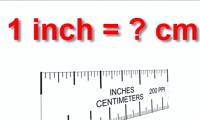
How many centimeters are in 1 inch?
By convention, 1 inch will have different values when converted to other units of measurement. The formula for converting from inches to centimeters is as follows:
X inch = X x 2.54 = Y cm
In there:
- X is the length in inches that needs to be converted to centimeters.
- Y is the length in centimeters after converting to inches.
For example, if you need to convert 3 inches to centimeters, the calculation would be: 3 x 2.54 = 7.62 cm.
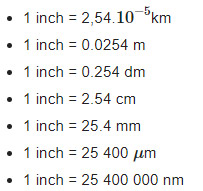
Convert 1 inch to km, m, cm, mm, dm, nm, µm
- 1 inch = 25,400,000 nm
- 1 inch = 25,400 µm
- 1 inch = 25.4 mm
- 1 inch = 2.54 cm
- 1 inch = 0.254 dm
- 1 inch = 0.0254 m
- 1 inch = 2.54 x 10⁻⁵ km
You can save this image to your computer/phone for future reference:
Inch to cm Conversion Chart
| Inches | Cm |
| 1 cake | 2.54 cm |
| 2 inches | 5.08 cm |
| 3 inches | 7.62 cm |
| 4 inches | 10.16 cm |
| 5 inches | 12.7 cm |
| 6 inches | 15.24 cm |
| 7 inches | 17.78 cm |
| 8 inches | 20.32 cm |
| 9 inches | 22.86 cm |
| 10 inches | 25.4 cm |
| Inches | Cm |
| 11 inches | 27.94 cm |
| 12 inches | 30.48 cm |
| 13 inches | 33.02 cm |
| 14 inches | 35.56 cm |
| 15 inches | 38.1 cm |
| 16 inches | 40.64 cm |
| 17 inches | 43.18 cm |
| 18 inches | 45.72 cm |
| 19 inches | 48.26 cm |
| 20 inches | 50.8 cm |
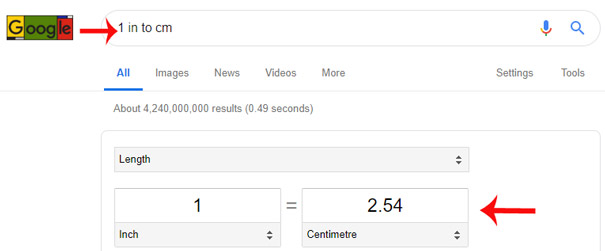
How to convert inches to millimeters, centimeters, and meters using Google.
Simply go to the Google homepage and type the following into the search box:
"1 in to cm" or "1 inch to cm"
Convert units of measurement using the ConvertWord tool.
Step 1 : Access the ConvertWord website.
- https://www.convertworld.com/vi/chieu-dai/
Step 2 : Select Length -> enter the quantity you want to convert -> select inches -> choose the desired conversion unit.
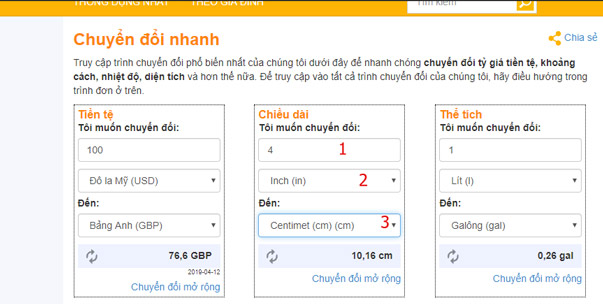
So, with these simple methods, you now know that 1 inch is approximately 2.54 cm, meaning 1 inch is larger than 1 cm, and how to convert inches to many other common units of measurement.
What is the inch unit used to measure?
Inch is a unit commonly used in electronic devices to measure the screen size of products such as televisions, laptops, and phones.
For example:
The TVs will come in sizes such as 32 inches, 40 inches, or 49 inches.
Laptops will come in various sizes, such as 13 inches, 14 inches, 15 inches, or even 16 inches.
By using the above method to convert inches to millimeters, centimeters, etc., hopefully you will know the size of the product you are using, whether it is large or small, and thus choose the most suitable product.
How to measure inches without a ruler
If you don't have a ruler or tape measure, there are several methods you can use to estimate or measure an inch:
Use common objects: Many everyday items already have known dimensions. For example, a standard U.S. 25-cent coin has a diameter of approximately 0.955 inches, so you can use that to estimate the length of an inch. Other items with known dimensions, such as credit cards or some smartphone models, can also be used as reference points.
Using your hand: For most people, the distance from the tip of the thumb to the first knuckle is about one inch. You can use this distance for a rough estimate by aligning the tip of your thumb with the starting point and counting the number of thumb lengths.
Remember that these methods are only approximate and may not provide precise measurements. It's best to always use a reliable measuring tool, such as a ruler or tape measure, to obtain accurate measurements whenever possible.
Different uses of Inch
- Inches are used to describe the size of a TV screen or display.
- It is also used to measure the length of smaller objects (such as pencils, paper, etc.).
- A tape measure is a portable tool used to measure length. It is marked in both centimeters and inches.
Interesting facts about inches
- The symbol for the inch unit is 'in' or a double comma (').
- Inches are commonly used to measure the length of smaller objects, such as household items, clothing sizes, height, etc.
- 12 inches = 1 foot
- An inch is longer than a centimeter because 1 in = 2.54 cm.
Frequently Asked Questions about the Inch Unit
Why is it called an inch?
The inch originates from the Latin word uncia, a Roman unit of length, meaning "twelfth" (of a Roman foot).
What is the relationship between inches and millimeters?
1 inch = 2.54 cm
1 cm = 10 mm
So, 1 inch = 25.4 mm
What is the relationship between inches and kilometers?
1 inch = 2.54 cm
So, 1 inch = 0.0000254 km
What is the relationship between inches and yards?
One yard equals 36 inches.
What is half an inch?
If you divide an inch into two equal parts, each part will be half an inch.
Inch in science and engineering
Inches are widely used in science and engineering, especially in the United States!
Engineers often design buildings and bridges in inches to ensure everything fits perfectly. Scientists can measure things like distances or sizes in inches when working with small objects. For example, microscopes can visualize tiny objects measured in inches!
Above are the things you need to know about inches, a common unit of measurement today, along with how to convert between them. As you can see, using inches isn't too difficult, is it?
Related Articles
 The Most Guide on How to Convert Inches to Centimeters4 minutes read
 Quiz: How Many Meters Is 1 Feet: Units of Foot Length2 minutes read
 How Many Inches Is 1 Inch: Convert Inch to M2 minutes read
 How to Convert Inches to Centimeters in Word 20162 minutes read
 Quiz: 1 Ha (ha) in How Many Square Meters, Square Kilometers3 minutes read
 How Many Square Meters Are in 1 Hectare6 minutes read
Reader Comments 0
Sign in with email or Google to join the discussion.