Table of Contents
MAX Function in SQL Server is easier to understand when the core ideas are paired with practical examples. The sections below explain the topic clearly, highlight useful steps, and point out details that can prevent common errors.
The article will explore and show you how to use the MAX function in SQL Server to find the maximum value in a set.
Describe
The MAX function in SQL Server is an aggregate function that returns the maximum value in a group.
Syntax
To use MAX function in SQL Server, we use the following syntax:
SELECT MAX(cot)FROM bang[WHERE dieukien];
Parameters :
- cot: column or calculated value, expression you want to find the largest value
- state: the table used to retrieve the record. Must have at least 1 table in the FROM clause.
- dieukien: optional. Conditions that the record must meet to be selected.
Note :
- MAX function can be used in later versions of SQL Server: SQL Server 2017, SQL Server 2016, SQL Server 2014, SQL Server 2012, SQL Server 2008 R2, SQL Server 2008, and SQL Server 2005.
For instance,
Take a look and explore some examples of MAX functions in SQL Server.
Suppose, we have the following data table:
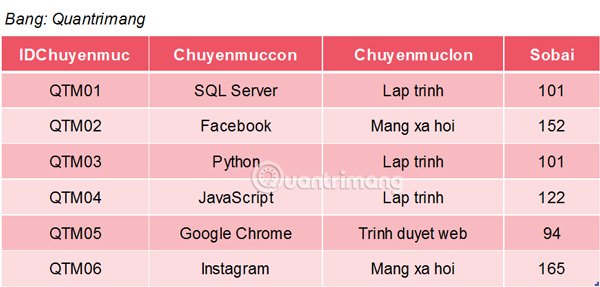
Example 1: Find the maximum number of posts in the table
SELECT MAX(Sobai)FROM TipsmakeWHERE Sobai < 100;Result: 122
In this example we have the highest number of articles in a column in the Tipsmake table, where the number of posts is less than 100.
Example 2: Use GROUP BY
The following example finds the largest value of all records related to a large section, you will do the following:
SELECT Chuyenmuclon, MAX(Sobai) AS 'So bai nhieu nhat'FROM TipsmakeGROUP BY Chuyenmuclon;Result:Chuyenmuclon So bai nhieu nhatLaptrinh 122Mang xa hoi 165Trinh duyet web 94
Next lesson: MIN function in SQL Server
FAQ
What should you know about describe?
The MAX function in SQL Server is an aggregate function that returns the maximum value in a group.
What should you know about syntax?
To use MAX function in SQL Server, we use the following syntax:
What should you know about for instance,?
Take a look and explore some examples of MAX functions in SQL Server.
Related Articles
 DAY Function in SQL Server: A Practical Guide2 minutes read
 MIN Function in SQL Server: Tips and Examples3 minutes read
 SQL Server Function: FUNCTION (Function) in SQL Server3 minutes read
 SUM Function in SQL Server: What You Need to Know4 minutes read
 Function Avg in SQL Server: AVG Function in SQL Server4 minutes read
 Function Abs in SQL Server: ABS Function in SQL Server2 minutes read
Reader Comments 0
Sign in with email or Google to join the discussion.