Table of Contents
NASA's OSIRIS-Rex spacecraft is powered by Earth to fly into space, beginning its journey to the asteroid Bennu taking a few specimens and returning to Earth in 2023. This article explains the key facts and context behind osiris-rex spacecraft.
- NASA will shoot asteroids close to Earth.
- Why did NASA choose Bennu as a model asteroid?
- A more than 4-kilometer asteroid is about to cross the Earth with the closest distance ever reached.
Key Facts About Osiris-rex Spacecraft
Atlas rocket successfully launched OSIRIS-Rex spacecraft on the evening of September 8, 2016 (local time) in Florida, USA. OSIRIS-Rex has been around for a year to fly around the Sun and it will fly over Earth today. Taking advantage of Earth's gravity and using planetary orbit, OSIRIS-Rex will reach a speed of nearly 13,700 km / h to reach its position in a plane with Bennu. As expected, in August 2018, OSIRIS-Rex will arrive at this asteroid.
Bennu asteroid was discovered in 1999, 500m high, more than the height of the Empire State Tower in the US and can collide causing serious consequences for our planet.
University of Arizona professor Dante Lauretta, who led the project, said if Bennu crashed into Earth, a collision would be equivalent to detonating 3 billion tons of TNT. At that time most of the life on the ground was blown away like 'hung god' that had swept away dinosaurs about 66 million years ago. The estimated risk of collisions is about 1: 2,700, and in the period from 2175 to 2196.
Why Osiris-rex Spacecraft Matters
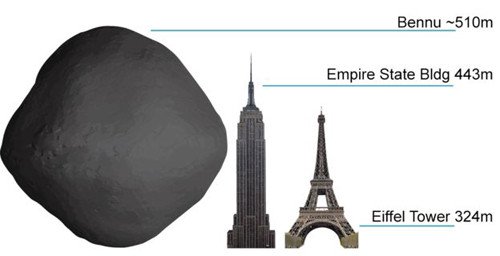 Bennu asteroid has a larger diameter than the height of Empire State Tower.(Graphic: BBC).
Scientists hope, the OSIRIS-Rex spacecraft will gain about 60 to 400 grams of the asteroid's specimens brought to Earth, opening Bennu's research opportunities more closely to its chemical properties and ways. Go through the solar system.
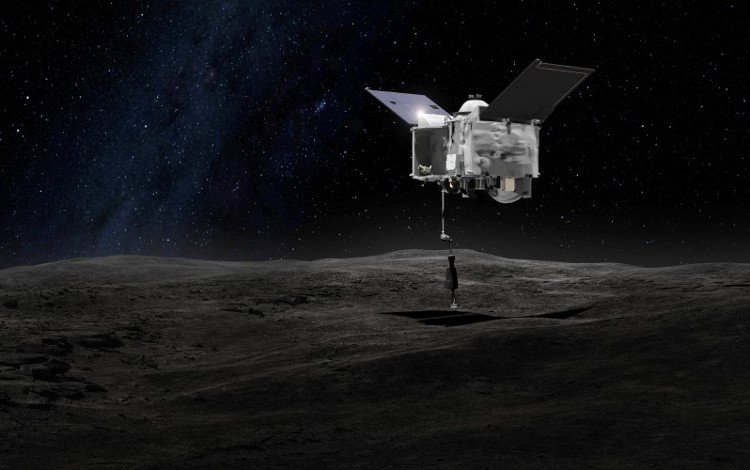
OSIRIS-REx will return to Earth in March 2021. Part of the ship will return home and drop the sample container into the Utah desert on September 24, 2023. The rest of it will continue to fly. follow the Sun's trajectory and serve NASA's next purposes.
If the specimen landed safely and intact, this would be the first time NASA brought it back from an asteroid.
FAQ
What is osiris-rex spacecraft?
NASA's OSIRIS-Rex spacecraft is powered by Earth to fly into space, beginning its journey to the asteroid Bennu taking a few specimens and returning to Earth in 2023.
What makes osiris-rex spacecraft notable?
This article explains the key facts and context behind osiris-rex spacecraft.
What are the key facts about osiris-rex spacecraft?
OSIRIS-REx will return to Earth in March 2021.
Related Articles
 NASA DART Mission Results: Asteroid Deflection Explained5 minutes read
 Spacecraft Crashes into Asteroid5 minutes read
 The Asteroid Is Similar in Size to the Pyramids of Giza, and Is3 minutes read
 Asteroid Half the Size of a Football Field Threatens Earth in 20323 minutes read
 Interesting Discoveries About Asteroids in the Solar System4 minutes read
 Asteroid 2024 YR4's Risk of Colliding with Earth Is Increasing4 minutes read
Reader Comments 0
Sign in with email or Google to join the discussion.